杻
Character Story & Explanation
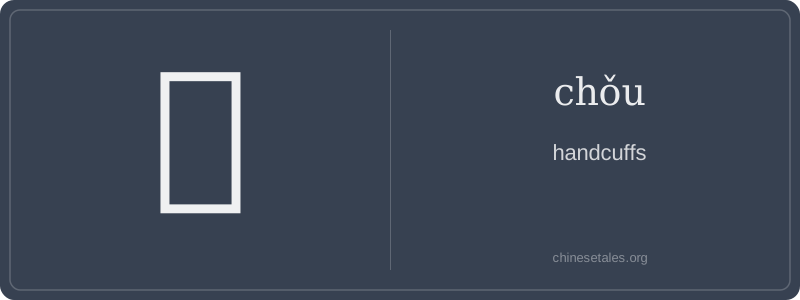
The earliest form of 杻 appears in Warring States bamboo slips and Han dynasty seals — not as a pictograph, but as a phono-semantic compound. Its left side, 木 (mù, ‘tree/wood’), signals material origin: ancient handcuffs were carved from hardwood like oak or catalpa, not forged iron. Its right side, 丑 (chǒu), originally depicted a twisted hand or contorted figure (in oracle bone script, 丑 resembled a bent arm gripping something), later standardized as the 2nd Earthly Branch. Over centuries, the hand motif simplified into the angular strokes we see today — the ‘7’-shaped top of 丑 fused with the vertical wood radical, yielding a compact, dense character that visually echoes confinement: tight, rigid, unyielding.
This character first appeared in legal texts like the *Book of Rites* (Lǐjì), where 杻 was paired with 枷 (jiā, ‘neck cangue’) to form 枷杻 — the full set of corporal restraints for convicted prisoners. Unlike modern handcuffs, 杻 were worn on the wrists *behind the back*, often linked to the neck cangue, enforcing both physical immobility and public shaming. Poets like Du Fu referenced them metaphorically — ‘杻械在手,岂能吟诗?’ (With restraints on my hands, how can I compose poetry?) — revealing how deeply 杻 embedded itself in China’s literary imagination as a symbol of silenced agency.
Let’s get real: 杻 (chǒu) isn’t a character you’ll see on subway ads or in beginner textbooks — and that’s precisely what makes it fascinating. It means 'handcuffs', yes, but not the shiny metal kind from crime dramas; it evokes ancient, wooden restraints used in Zhou- to Han-dynasty judicial practice — heavy, ritualized, and deeply symbolic of authority and restraint. The word carries a literary, almost archaic weight: you’ll encounter it in classical texts or historical novels, never in casual speech like 'I forgot my keys' — there’s no 'my 杻 broke'!
Grammatically, 杻 functions almost exclusively as a noun — usually in compound words (like 枷杻) or poetic phrases — and rarely stands alone. You won’t say *‘chǒu le tā’* (‘handcuffed him’) — that verb role belongs to 动词 like 戴上 or 锁上. Instead, you’ll read ‘身戴枷杻’ (wearing shackles and handcuffs), where 杻 appears as part of a parallel, rhythmic binome. Learners sometimes misread it as niǔ (a valid alternate reading in rare contexts like dialectal variants or mistaken homophone substitution), but in standard modern usage meaning ‘handcuffs’, chǒu is the only correct pronunciation.
Culturally, 杻 isn’t just hardware — it’s a metonym for injustice, oppression, or righteous punishment, depending on context. In classical poetry, it can symbolize moral constraint (e.g., ‘心为名利杻’ — ‘the heart bound by fame and profit’). A common mistake? Confusing it with 扭 (niǔ, ‘to twist’) due to similar sound and shared niǔ reading — but their meanings and origins are worlds apart. Remember: 杻 binds wrists; 扭 twists wrists — same hands, opposite intentions.