杸
Character Story & Explanation
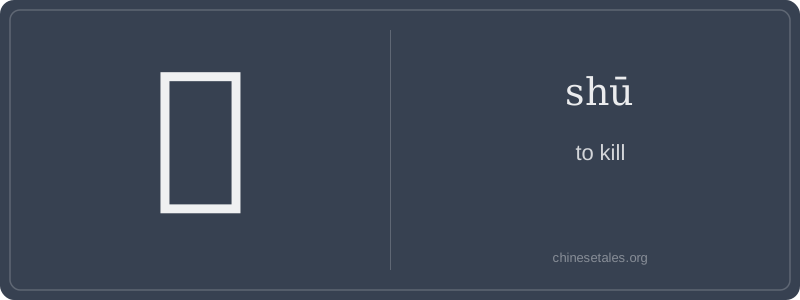
The earliest form of 杸 appears on late Shang oracle bones as a complex pictograph: a hand holding a sharp blade (often stylized as a downward stroke with a hook) poised over a prone human figure (represented by a bent line or dot-cluster). By Western Zhou bronze inscriptions, the human element simplified into a horizontal stroke beneath the blade-hand, and the weapon morphed into the top component resembling 疋 (pǐ, an archaic unit of cloth — but here purely phonetic). Over centuries, clerical script flattened the hand into the left radical 彐 (jì, ‘winnowing basket’ shape), while the right side hardened into 呼 (hū) — not for breath, but as a phonetic loan. The modern form 杸 crystallized in Song dynasty dictionaries as a deliberate archaism.
This character never meant ‘murder’ in the chaotic sense — it signified sanctioned, decisive termination: executing a traitor, pruning a corrupt branch of the clan, or ritually ending a failed sacrifice. Confucius’s *Analects* doesn’t use it, but the *Book of Rites* employs 杸 in contexts where moral failure demands irreversible correction — linking killing to cosmic hygiene. Visually, the left 彐 suggests containment or judgment; the right 呼 evokes the last exhalation — making 杸 a silent, two-part death rattle in ink.
Let’s be clear: 杸 (shū) is a ghost character — haunting classical texts but absent from modern speech and the HSK. Its core meaning ‘to kill’ isn’t just physical violence; in ancient usage, it carried a chillingly precise, almost ritualistic weight — like cutting off a branch to stop decay, or ending something decisively to preserve order. Think less 'stab' and more 'terminate with extreme linguistic prejudice.' It’s not used alone today; you’ll never hear someone say ‘wǒ yào shū tā’ — that would sound like quoting a bronze inscription at a dinner party.
Grammatically, 杸 appears only in fixed literary compounds or as a rare variant of 殊 (shū, ‘extraordinary’) or 戮 (lù, ‘to slaughter’), especially in pre-Qin bamboo manuscripts. In the *Zuo Zhuan*, for instance, it occasionally substitutes for 戮 in phrases like ‘shū ér bù yǐ’ (to kill without ceasing), always paired with classical particles like 而 or 以. Learners who stumble upon it in old texts often misread it as 殊 or even 朮 — a mistake that flips meaning from ‘kill’ to ‘exceptional’ or ‘art/technique.’
Culturally, 杸 reveals how Chinese writing preserves semantic nuance like fossilized amber: its rarity isn’t neglect — it’s reverence. Scribes kept it alive precisely because it encoded a specific, non-replaceable shade of finality. Modern learners shouldn’t memorize it for conversation — but spotting it is like finding a hieroglyph in a subway ad: a whisper from China’s grammatical deep time.