杳
Character Story & Explanation
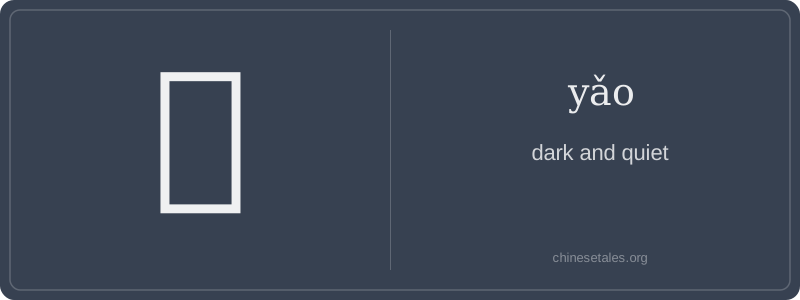
The earliest form of 杳 appears in seal script as two stacked 'sun' (日) components above a 'tree' (木) — but wait! That’s a myth. In fact, oracle bone inscriptions show no trace of 杳; it first emerged in Warring States bamboo texts as a compound: the top is actually the ancient form of 木 (mù, 'tree') repeated — not 日 — and the bottom is also 木, stylized into what became the modern radical. The double-wood motif visually suggests depth: trees layered upon trees receding into misty distance, their trunks blurring into indistinguishable shadow.
This visual stacking directly birthed its meaning: profound remoteness where forms vanish. By the Han dynasty, scholars like Xu Shen recorded it in the Shuōwén Jiězì as 'deep and unseen' (深而不见), linking it to the disappearance of sunlight behind dense forest canopies. In Tang poetry, Du Fu used 杳 in '杳杳寒山道' — 'the faint, cold mountain path' — where the repetition of 杳 (in 杳杳) mimics the echoing hollowness of footsteps fading into fog. Its shape doesn’t depict darkness literally — it *enacts* disappearance through layered, indistinct strokes.
At its heart, 杳 (yǎo) evokes a deep, resonant stillness — not just physical darkness, but the hush of an abandoned valley at dusk, where sound dissolves and light vanishes. It’s poetic, literary, and almost tactile: you don’t *see* 杳 — you *feel* its absence. Unlike common words for 'dark' like 黑 (hēi) or 暗 (àn), 杳 carries quietude as inseparable from darkness — it’s the silence *inside* the dark, not just the lack of light.
Grammatically, 杳 is almost never used alone in modern speech; it appears only in fixed, classical-style compounds or as an adverbial modifier (e.g., 杳然, 杳无音信). You’ll never say 'the room is 杳' — instead, it modifies verbs or nouns to intensify absence or remoteness: 杳无踪迹 (yǎo wú zōng jì, 'vanished without a trace') or 杳不可见 (yǎo bù kě jiàn, 'so distant as to be invisible'). Learners often mistakenly try to use it predicatively like an adjective — a classic fossil-word trap.
Culturally, 杳 breathes with Daoist and Tang poetry sensibility — think of Wang Wei’s mist-shrouded mountains or Li Bai’s lonely moonlit paths. It’s the character poets reach for when describing something profoundly unreachable, not just physically far but existentially withdrawn. A common error? Confusing it with 幽 (yōu, 'secluded, dim'), which suggests gentle mystery — whereas 杳 feels colder, more absolute, even slightly ominous in its total withdrawal.