杲
Character Story & Explanation
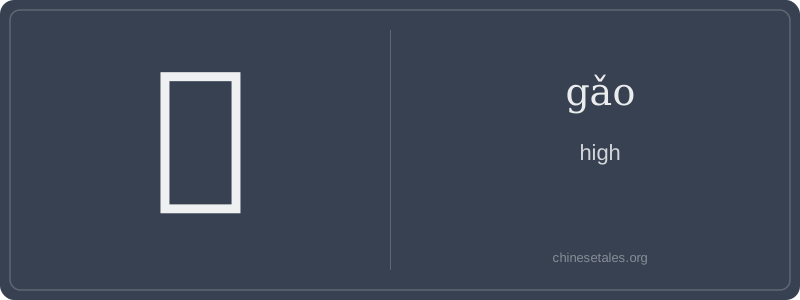
The earliest form of 杲 appears in seal script (c. 3rd century BCE), where it vividly combines two elements: 日 (rì, 'sun') perched atop 木 (mù, 'tree'). Imagine a bright sun rising *above* a tall tree — not beside or behind, but unmistakably *high above*, dominating the vertical space. This wasn’t abstract: oracle bone inscriptions show the sun glyph drawn larger and centered directly over the simplified trunk-and-branches of the tree. Over centuries, the sun shrank to a compact square (the top 日), while the tree evolved into the standard 木 radical — its horizontal stroke becoming the 'roof' line, and the two downward strokes sharpening into clean legs. Eight strokes total: four for 日, four for 木 — no extra flourishes, pure structural hierarchy.
This visual logic cemented its meaning: 'high' as vertical supremacy, especially when light (sun) asserts dominance over earth (tree). In the Shijing (Classic of Poetry), 杲 appears in the phrase 杲杲出日 — 'the sun rises gǎo gǎo', evoking dazzling, unclouded ascent. Later, in Tang poetry, it extended metaphorically: 杲如明月 ('bright as the full moon') implied luminous clarity of thought. Crucially, the character never lost its solar-tree origin — every time you write those eight strokes, you’re tracing an ancient horizon where light climbs above life.
At first glance, 杲 (gǎo) feels like a quiet, almost forgotten character — it’s not in the HSK, rarely appears in modern textbooks, and even many native speakers pause before recalling its meaning: 'high', 'lofty', or 'brilliant' (in classical contexts). But don’t mistake its rarity for simplicity. This is a character steeped in poetic elevation — think of a sun blazing above treetops, not just altitude but luminous prominence. Its core feeling is *ascent with radiance*: upward movement fused with clarity and visibility.
Grammatically, 杲 functions almost exclusively as an adjective — but only in literary or archaic registers. You won’t hear it in daily speech ('That building is gǎo!') — instead, it appears in fixed compounds like 杲杲 (gǎo gǎo), where reduplication intensifies the sense of brilliant, unobstructed brightness (e.g., 'the sun shines gǎo gǎo'). It never takes aspect particles (了, 过) or comparative suffixes (更, 最); its grammar is frozen in elegance. Learners sometimes misread it as a variant of 高 (gāo, 'high'), but that’s a critical error — they’re etymologically unrelated and visually distinct once you know the trick.
Culturally, 杲 carries a subtle Confucian resonance: highness here isn’t just physical — it’s moral or intellectual eminence, like a sage’s insight shining clear and elevated above confusion. Modern writers occasionally resurrect it for rhetorical weight — a poet describing dawn light, or a historian praising 'a gǎo ideal'. The biggest trap? Assuming it’s interchangeable with 高. It’s not — using 杲 where 高 belongs sounds archaic, jarring, or even comically pretentious. Think of it as the 'sonnet form' of 'high': beautiful, precise, and reserved for moments that demand lyrical gravity.