朳
Character Story & Explanation
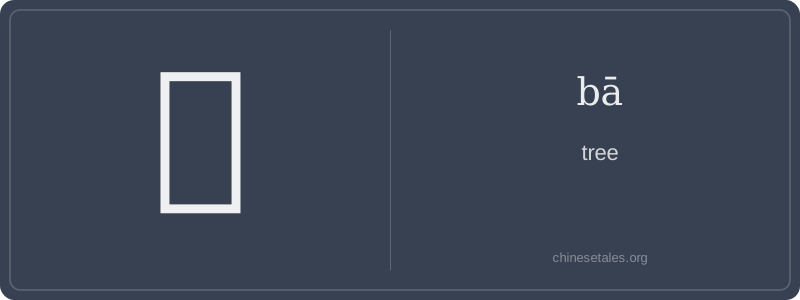
The earliest form of 朳 appears in Han dynasty bamboo slips as a simple pictograph: two parallel diagonal strokes (like and /) above a horizontal base — representing tines or prongs mounted on a wooden handle. Over centuries, the top evolved into the phonetic component 八 (bā), while the bottom solidified into the 木 (mù, 'wood') radical, clarifying both sound and substance. By the Tang dynasty, the character had stabilized into its current shape: 八 over 木 — visually echoing how a rake’s prongs splay outward like the number eight, anchored by its wooden shaft.
This evolution reflects ancient Chinese craftsmanship: tools were named by combining sound (八) and category (木). Unlike poetic tree characters like 林 (lín, 'grove') or 森 (sēn, 'dense forest'), 朳 carries no metaphorical weight — it’s strictly utilitarian. You won’t find it in the Shijing or Dao De Jing, but it does appear in Song-era agricultural treatises like Nong Shu (《农书》), where it’s described as essential for ‘gathering fallen stalks after threshing’. Its shape isn’t a tree — it’s a tool shaped like an open hand gripping straw.
Hold on — there’s a problem. The character 朳 does not mean 'tree'. It’s actually a farming tool: a wooden rake or fork used for gathering hay, straw, or grain. This is a classic case of mistaken identity — many learners encounter 朳 in old dictionaries or OCR errors and assume it’s a variant of 柏 (bǎi, 'cypress') or 杉 (shān, 'fir'), but no: 朳 is a humble, earthy implement, not a botanical one. Its feel is rustic, practical, and regional — you’ll almost never hear it in modern Beijing Mandarin, but it still appears in northern dialects, agricultural manuals, and classical poetry describing rural labor.
Grammatically, 朳 functions as a noun, often paired with verbs like 拿 (ná, 'to hold'), 用 (yòng, 'to use'), or 搂 (lōu, 'to rake'). It rarely appears alone; instead, it shows up in compound terms like 朳子 (bā·zi) or in fixed phrases such as '朳草' (bā cǎo, 'raking grass'). Learners sometimes misread it as 八 (bā, 'eight') due to identical pronunciation and visual similarity — but confusing them turns 'hand rake' into 'eight', causing delightful nonsense: 'I used eight to gather wheat'.
Culturally, 朳 evokes pre-industrial agrarian life — think late Ming dynasty woodblock prints or Shaanxi folk operas where peasants wield long-handled 朳s at harvest time. It’s absent from the HSK precisely because it’s functionally obsolete in urban speech — yet it survives in idiom, place names (e.g., 朳朳沟 in Shanxi), and linguistic archives. A common mistake? Assuming it’s related to trees just because it has the 木 (wood) radical — but here, 木 signals the material (wooden tool), not the referent (a plant).