朱
Character Story & Explanation
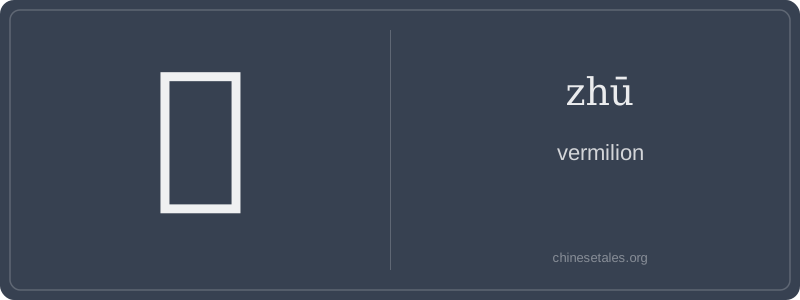
The earliest form of 朱 appears in oracle bone inscriptions as a simple cross inside a square——symbolizing the concentrated, life-force red of cinnabar ore, often stored in ritual containers. By the bronze script era, it evolved into a symmetrical glyph: two short horizontal strokes flanking a central vertical stroke, all enclosed within a soft, box-like frame (the precursor to today’s 木 radical). Over centuries, the enclosing frame hardened into the recognizable 木 (wood) radical at the bottom, while the top simplified to 丿 and 一—now read as a stylized ‘dot-and-line’ abstraction of concentrated pigment. The six strokes we write today—丨 一 丿 丶 一 丨—aren’t random: they mirror the balance and centrality of this sacred color.
This character’s meaning stayed remarkably stable: from Shang dynasty divination powder to Han dynasty lacquerware pigment to Song dynasty scholarly commentary ink, 朱 always signified *the red that commands attention*. Confucius himself praised ‘vermilion and black’ (朱墨) as the proper duality of annotation—vermilion for correction, black for original text. Even today, teachers sometimes mark errors in red ink—a quiet echo of 朱’s ancient role as the color of judgment, clarity, and enduring truth.
Picture a vivid, almost electric red—the kind that stains silk, glows on imperial palace gates, and pulses in traditional ink paintings. That’s 朱 (zhū): not just ‘red’, but *vermilion*—a specific, luminous, mineral-based red with deep cultural gravity. In ancient China, vermilion wasn’t decorative; it was ritual, authority, and permanence—used to seal edicts, annotate classics, and mark auspicious dates. So 朱 carries weight: it’s poetic, formal, and slightly archaic in daily speech, rarely used for everyday ‘red’ (that’s 红 hóng). You’ll see it in compound words, surnames (like Zhu Xi), or classical phrases—not as a standalone adjective like ‘the apple is red’.
Grammatically, 朱 functions mostly as a noun (‘vermilion pigment’) or an attributive noun in compounds (e.g., 朱砂 zhūshā ‘cinnabar’). It almost never appears predicatively (*✘ 这个很朱*); instead, you’d say 朱红色的 (zhūhóngsè de) — literally ‘vermilion-red-colored’. Learners often mistakenly use 朱 alone to mean ‘red’, leading to unnatural or comically stiff phrasing. Think of it like using ‘ochre’ instead of ‘brown’ in English—it’s precise, evocative, and reserved for context where color history matters.
Culturally, 朱 is inseparable from power and refinement: Ming dynasty emperors wore 朱衣 (zhū yī, ‘vermilion robes’); scholars annotated texts in 朱批 (zhū pī, ‘vermilion comments’)—a mark of imperial or masterly authority. Its radical 木 (wood) hints at its origin: early vermilion was made by grinding cinnabar ore *with wooden tools*, or possibly from the red heartwood of certain trees. That subtle wood-rootedness still echoes in its structure—six clean strokes, balanced and upright, like a ceremonial brushstroke frozen in time.