札
Character Story & Explanation
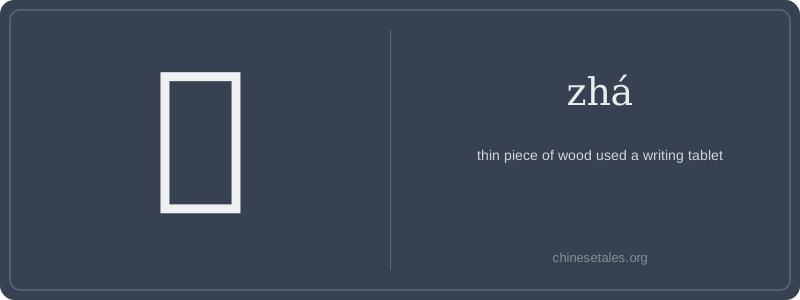
The earliest forms of 札 appear in Warring States bamboo manuscripts as a simple, elegant glyph: a vertical stroke for the wooden strip, crossed near the top by a short horizontal — representing an incised character or knot marking. Over centuries, the horizontal hardened into the 乚 curve we see today, while the left side standardized into 木, anchoring its material identity. Its five strokes are deceptively minimal: two for the tree radical (一 and 丨), then three for the right — a tiny horizontal, a downward stroke, and the final graceful hook — mirroring how a scribe would carve one clean line into seasoned wood.
This humble tablet became the medium of empire: Han dynasty generals sent battle dispatches on 札, Tang poets exchanged refined literary notes (called 尺牍 or 书札), and Song scholars annotated classics on layered bamboo 札. In the Book of Rites, 札 appears in contexts describing ritual documents written on ‘three-inch-wide wood’. Its visual simplicity — just wood plus a single mark — reflects its function: not decoration, but precision communication. Even today, when a calligrapher writes 信札, they’re echoing that 2,300-year-old gesture of carving meaning into wood.
Imagine holding a slender, smooth strip of wood — not for building, but for writing. That’s the soul of 札 (zhá): a thin wooden tablet used in ancient China before paper existed. It’s not just ‘wood’ + ‘something’ — the character breathes quiet dignity, evoking scholars hunched by lamplight, inscribing urgent military reports or poetic musings onto carefully prepared strips. The 木 (mù) radical at the left grounds it in material reality — this was literal timber — while the right side 乚 (yǐn), a subtle curved stroke, suggests both the narrow shape of the tablet and the act of inscribing a line into its surface.
Grammatically, 札 is almost never used alone today; it appears almost exclusively in classical or literary compounds like 信札 (xìn zhá, ‘letter’) or 奏札 (zòu zhá, ‘memorial to the emperor’). Learners sometimes mistakenly treat it as a generic ‘note’ — but unlike 纸条 (zhǐ tiáo, ‘paper note’) or 备忘录 (bèi wàng lù, ‘memo’), 札 carries historical weight and formality. You wouldn’t send a 札 to your roommate about borrowing sugar — it belongs in archives, calligraphy collections, or historical novels.
Culturally, 札 embodies the tactile intimacy of pre-paper literacy: bamboo slips bound with silk cords, ink bleeding slightly into grain, messages carried across mountains by mounted couriers. A common learner trap? Confusing it with 扎 (zhā/zhá/zā) — same pinyin but completely unrelated meaning (‘to pierce’, ‘to settle’). Remember: 札 has wood, so it’s *written on* — not *stabbed with*.