朣
Character Story & Explanation
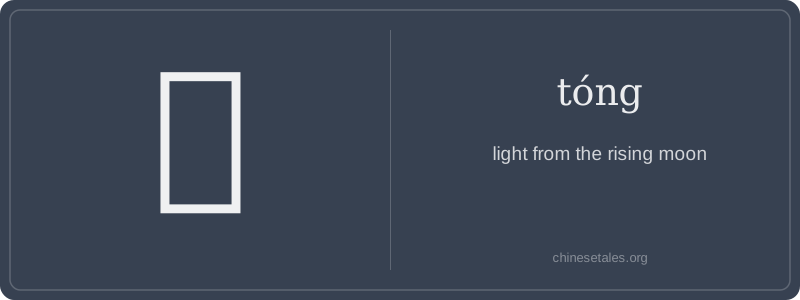
The character 朣 first appeared in late Han and Six Dynasties stele inscriptions—not oracle bones—and is a phono-semantic compound. Its left radical 月 (yuè, ‘moon’) anchors the meaning, while the right component 彳+童 (originally a simplified phonetic variant of 童 tóng, ‘child’) provides pronunciation. Early forms show 月 tightly bound to a stylized 重 or 童-like shape, gradually simplifying into today’s clean 9-stroke form. Crucially, it was *not* pictographic—it was invented to fill a lexical gap: Chinese needed a word for that exact, fleeting moment when moonlight feels both tender and vanishing.
By the Tang dynasty, poets like Li He and Wang Wei used 朣 in paired compounds like 朣胧 and 朣朦 to evoke misty, indistinct pre-dawn luminescence—never full moonlight or starlight. In the Wen Xuan anthology, it appears in descriptions of rivers reflecting the ‘last breath’ of the moon. The visual structure reinforces its meaning: 月 (moon) + ‘tóng’ (a homophone suggesting youth, transience, and softness—like a child’s quiet presence), making 朣 feel like ‘the moon’s hushed farewell’.
Imagine standing on a quiet lakeshore at dawn—just before sunrise—when the last sliver of moon still hangs low in the pale sky, glowing with a soft, silvery luminescence against the bluing horizon. That delicate, ethereal light? That’s 朣 (tóng). It doesn’t mean ‘moon’ or ‘light’ alone—it’s *exclusively* the gentle, transient radiance cast by the *waning moon near daybreak*, a poetic nuance so specific it has no direct English equivalent. Native speakers rarely use it in daily speech; you’ll find it only in classical poetry, lyrical essays, or highly stylized prose.
Grammatically, 朣 is almost always a noun modifier: it appears in compounds like 朣朦 (tóng méng) or 朣胧 (tóng lóng), never standalone as a verb or adjective. Learners sometimes misread it as ‘bright’ and insert it where 晴 (qíng) or 明 (míng) belong—but that’s like calling twilight ‘noon’. It’s also tone-sensitive: tóng (second tone), not tōng (first) or dòng (fourth)—mispronouncing it risks sounding like ‘copper’ (铜) or ‘child’ (童).
Culturally, 朣 embodies a Daoist aesthetic: impermanence, quiet transition, and luminous ambiguity. Its rarity makes it a hallmark of literary refinement—if you spot it in a modern essay, the writer is deliberately evoking Tang dynasty elegance. A common mistake is overusing it for any moonlight; remember: 朣 = *dawn-adjacent, fading lunar glow only*. Confuse it with 朦 or 胧, and you lose the temporal precision that makes this character shimmer.