朕
Character Story & Explanation
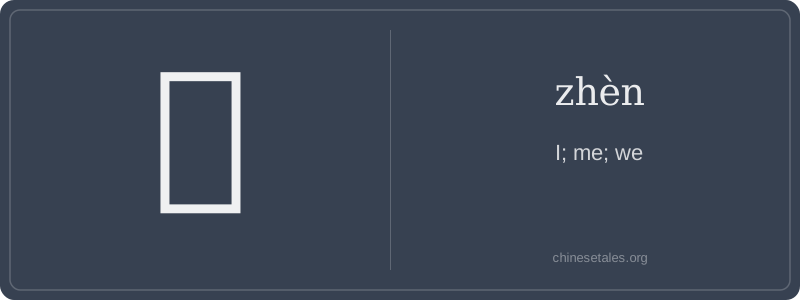
The earliest form of 朕 appears on Warring States bamboo slips and Han dynasty seals — not as a pictograph of a body part, but as a phonosemantic compound. Its left side 月 (yuè, ‘moon’ or ‘flesh’) was originally 肉 (ròu, ‘flesh’), simplified over centuries to resemble 月. The right side 关 (guān) — later stylized into 關 → → 丷 + 一 + 丨 — wasn’t a gate, but a phonetic clue hinting at ancient pronunciation *tən*. Crucially, oracle bone inscriptions show no direct precursor; 朕 emerged as a *written innovation*, likely coined by Qin Shi Huang’s scholars to replace the humble 我 and elevate imperial speech into its own lexical stratosphere.
Its semantic rise is staggering: before Qin unification (221 BCE), 朕 was just a modest first-person pronoun used by nobles and even commoners — like ‘I’ in Old English ‘ic’. But when Qin Shi Huang declared himself First Emperor, he decreed 朕 *exclusively* for imperial use — a linguistic coronation. Sima Qian records this in the *Shiji*: ‘天子自称曰朕’ (‘The Son of Heaven refers to himself as zhèn’). Visually, the 10 strokes now feel regal: the rounded 月 grounds the character like a throne base, while the upright 丷+一+丨 rises like a scepter — a perfect fusion of sound, script, and sovereign power.
Let’s get real: 朕 (zhèn) isn’t just ‘I’ — it’s *the* I. The royal, thunderous, slightly terrifying first-person pronoun reserved exclusively for Chinese emperors from the Qin dynasty onward. It doesn’t feel humble or casual like 我 (wǒ); it feels like stepping onto a marble dais wearing dragon robes. Its tone is commanding, ceremonial, and deeply archaic — you’ll never hear it in modern speech, only in historical dramas, classical poetry, or satirical memes (like an emperor sighing, ‘朕累了’ — ‘This Emperor is tired’).
Grammatically, 朕 functions exactly like 我: subject position, no plural marker needed (it’s inherently majestic-plural), and it takes the same verb complements. But crucially, it *cannot* be used with possessive 的 — you’d never say *朕的* in classical Chinese; instead, you’d use constructions like 朕躬 (zhèn gōng, ‘this Emperor’s person’) or simply context. Learners sometimes overuse it thinking it sounds ‘cool’ — a classic faux pas that turns a language learner into a self-proclaimed emperor at the dumpling shop.
Culturally, 朕 carries imperial weight so heavy that after 1912, its use vanished from official life — yet it lives on as linguistic theater. Mispronouncing it as zhēn (first tone) is common, but zhèn (fourth tone) echoes the sharp, decisive cadence of an edict. Think of it not as a word, but as a seal pressed in vermilion ink: authoritative, irrevocable, and utterly out of reach for mere mortals — including you and me.