朔
Character Story & Explanation
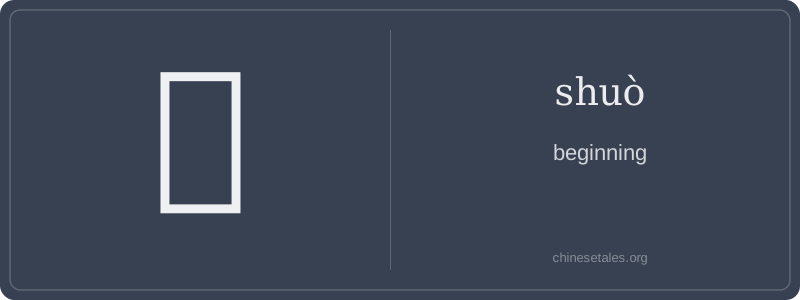
The earliest form of 朔 appears in bronze inscriptions as a complex pictograph: a large, stylized ‘moon’ () cradled within a ‘gate’ or ‘enclosure’ (), with a small dot or stroke inside the moon — symbolizing the *invisible sliver* of the new moon at its precise rebirth, hidden behind the gate of darkness. Over centuries, the enclosure simplified into the left component (), the dot became the central 丶, and the moon radical 月 settled firmly at the bottom — preserving the celestial essence despite visual streamlining.
This visual logic shaped its meaning: 朔 didn’t just mean ‘start’ — it meant *the first observable moment after lunar invisibility*, a concept so vital that the Zhou dynasty mandated official ceremonies on 朔日. Confucius noted in the *Analects* how virtuous rulers ‘listened to governance on 朔日’. Even today, 朔风 evokes not just cold wind, but the sharp, clarifying bite of winter’s first breath — tying meteorology to cosmic rhythm. The character’s shape is literally a moon born anew within boundaries — a perfect fusion of astronomy, authority, and austerity.
朔 (shuò) is the quiet, ancient heartbeat of beginnings — not the cheerful 'start' of 开始, but the solemn, cosmic first moment: the new moon’s invisible birth, the first day of the lunar month, the raw edge of time itself. Its core meaning isn’t generic ‘beginning’ but *ritual, calendrical, astronomical inception* — a word that still echoes in imperial edicts and classical poetry. You’ll almost never use it alone in speech; it lives in formal compounds like 朔日 or 朔风, carrying weight and reverence.
Grammatically, 朔 functions as a noun or attributive modifier, never as a verb. Learners often mistakenly try to say ‘I begin studying’ with 朔 — nope! It doesn’t conjugate or take objects. Instead, it anchors time: 朔日 (shuò rì) means ‘the first day of the lunar month’, and 朔风 (shuò fēng) literally means ‘north wind’ — because in ancient China, the ‘northern direction’ was associated with the beginning of the year and winter’s onset, linking cardinal direction to cyclical origin. Note the tone: shuò, not shuō or shù — mispronouncing it risks sounding like ‘to speak’ or ‘number’.
Culturally, 朔 carries Daoist and cosmological gravity. In the *Zuo Zhuan*, rulers issued decrees on 朔日 — the moment heaven realigned the calendar. Modern learners may encounter it in historical dramas or lunar festival contexts, but rarely in daily texting. A common mistake? Confusing it with 逆 (nì, ‘to oppose’) due to similar top strokes — but 朔’s bottom is 月 (moon), grounding it in time, not resistance.