暸
Character Story & Explanation
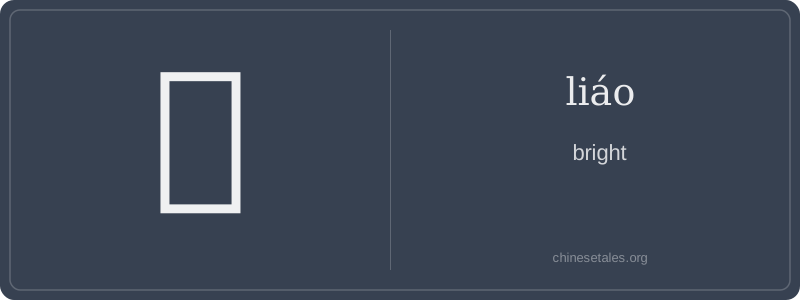
The earliest form of 暸 appears in seal script (c. 3rd century BCE), where it clearly combines 日 (rì, 'sun') on the left — a square with a central dot, symbolizing solar radiance — and 辽 (liáo, originally 'distant, vast') on the right, which itself evolved from a pictograph of a person walking across open terrain. Over centuries, the right side simplified: the original 'person + winding path' became 辶 (chuò, the 'walk' radical) plus 了 (le), then further stylized into 辽 and finally the modern 辽 component. The sun radical remained proudly central to its identity.
This visual marriage tells the story: brightness so profound it stretches across vast distances — like sunlight flooding a boundless plain. In classical texts such as the Wen Xin Diao Long (5th c. CE), 暸 described mental lucidity: 'a mind 暸然 — clear as polished jade under noon sun.' Its meaning never drifted into physical glare or heat; it stayed rooted in *clarity of perception*. Even today, when used in phrases like 暸如指掌, it evokes not just knowledge, but *immediate, radiant understanding* — as if truth shines unobstructed, no shadows left to hide in.
Think of 暸 (liáo) as the Chinese equivalent of 'luminescent'—not just bright, but radiantly, almost spiritually luminous. It’s not the everyday brightness of a lightbulb (that’s 亮 liàng), but the kind you’d use for a sun-drenched mountain peak at dawn or a suddenly clarified insight—like flipping a switch in your mind. In classical and literary contexts, it carries poetic weight: it’s the brightness of truth piercing illusion, not mere illumination.
Grammatically, 暸 is almost never used alone in modern speech—it’s strictly literary or poetic. You’ll find it mostly in set compounds (like 暸亮 or 暸如指掌) or as part of formal written descriptions. Learners often mistakenly try to substitute it for 亮 in casual speech ('This room is liáo!'), but that sounds archaic or jarringly solemn—like saying 'verily' instead of 'really' in English. It’s a character that *wears silk robes*, not jeans.
Culturally, its rarity makes it a quiet marker of linguistic sophistication: spotting 暸 in a poem signals intentional artistry, not accidental vocabulary. A common mistake is misreading its left radical (日 rì, 'sun') as 月 yuè ('moon')—but no, this character is all about solar clarity. Also, don’t confuse it with 瞭 (the simplified form used in mainland China for 'to look out'); they’re homophones but different characters with divergent histories and uses—more on that in 'similar'.