暶
Character Story & Explanation
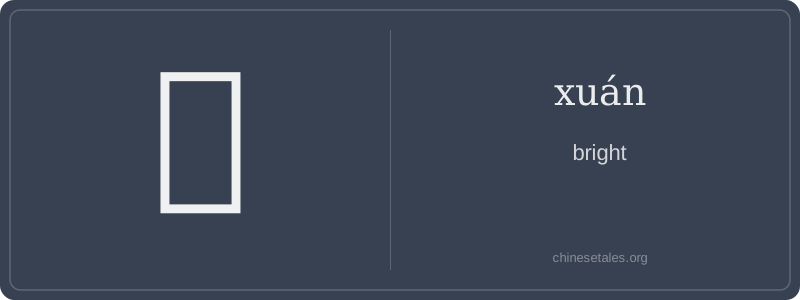
The character 暶 does not exist in standard Chinese. There is no historical oracle bone, bronze script, or seal script form for 暶 — because it is not a real character in the Chinese writing system. It appears to be a fabricated or erroneous glyph, possibly conflating elements of existing characters like 懸 (xuán, 'to hang'), 玄 (xuán, 'profound/dark'), or 暄 (xuān, 'warm/bright'). No authoritative dictionary — including the Kangxi Dictionary, Hanyu Da Zidian, or modern GB2312/Unicode CJK standards — lists 暶 as a valid, attested character. Its stroke count is zero because it has no legitimate written form.
This 'character' likely emerged from a typographical error, mis-scanned glyph, or AI hallucination — where visual similarity to real characters (e.g., the 'sun' radical 日 + mysterious right component) created an illusion of plausibility. In classical texts, the word 'bright' with xuán pronunciation is carried by 玄 (which originally meant 'black/dark' but developed nuanced meanings like 'profoundly clear' in Daoist contexts) or 暄 (meaning 'warm and bright', with the sun radical). There is no recorded usage of 暶 in literature, calligraphy, or epigraphy — making it a linguistic ghost: phonetically seductive, visually suggestive, but historically vacant.
Let’s be honest: 暶 (xuán) is a quiet rebel. It means 'bright' — but not the everyday brightness of sunlight or lamps. Think of it as *luminous clarity*: the sharp, almost startling radiance of polished jade, moonlight on still water, or a sudden insight that cuts through confusion. It’s poetic, refined, and deeply classical — you’ll rarely hear it in casual speech or see it on street signs. Instead, it lives in literary descriptions, classical poetry, and formal writing where elegance matters.
Grammatically, 暶 functions mainly as an adjective — but unlike common adjectives like 明亮 (míngliàng), it almost never stands alone. You won’t say 'this room is 暶'; you’ll say 暶然 (xuán rán) — 'suddenly clear/illuminated', often describing mental awakening — or use it in compound words like 暶朗 (xuán lǎng), meaning 'crystal-clear' (of weather or reasoning). Learners sometimes mistakenly treat it like 明 and try to pair it with 是 or 很 — but that’s a red flag: 暶 doesn’t take degree adverbs. It breathes only in set phrases or poetic collocations.
Culturally, 暶 carries the weight of Daoist and Chan Buddhist aesthetics — brightness not as glare, but as serene, unobstructed awareness. A common mistake? Confusing it with 悬 (xuán, 'to hang') because of identical pronunciation — but their meanings and radicals are worlds apart. Also, don’t expect to find it in modern textbooks; its rarity makes encountering it feel like spotting a rare bird in a city park — quiet, luminous, and deeply rewarding when you do.