晢
Character Story & Explanation
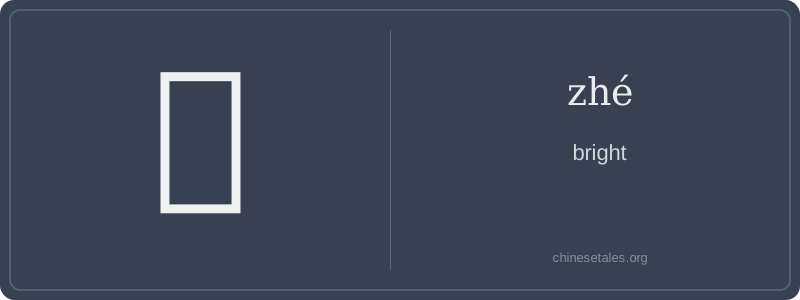
The earliest form of 晢 appears in bronze inscriptions from the Western Zhou dynasty (~1046–771 BCE), where it was written as 日 (rì, ‘sun’) above 折 (zhé, ‘to break, bend’ — originally depicting a hand holding a tool that bends or severs something). This wasn’t literal ‘broken sun’ — rather, it evoked the *sun at its most decisive, clarifying moment*: dawn, when light ‘breaks through’ darkness with unmistakable authority. Over centuries, the 折 component simplified and stylized, losing its hand-and-tool detail and gaining the ‘knife’ radical (刂) on the right, while the 日 remained proudly centered — a visual promise of unambiguous illumination.
By the Han dynasty, 晢 had crystallized into its modern shape and acquired philosophical gravity. In the *Book of Rites* (*Lǐjì*), it appears in phrases like ‘晢然可观’ (zhé rán kě guān), describing rites so clearly structured they are ‘brightly observable’ — implying moral transparency, not mere visibility. The character’s structure reinforces this: the sun (日) is *unobstructed*, and the ‘cutting’ action (刂) suggests intellectual precision — cutting through confusion. Even today, its use signals a deliberate turn toward elegance, erudition, or reverence — never casual light.
晢 (zhé) is a poetic, literary word meaning 'bright' — but not the everyday brightness of a lightbulb or sunshine. Think instead of luminous clarity: the sharp, penetrating brightness of insight, wisdom, or moral radiance. It’s the kind of brightness you’d find in classical texts describing a sage’s discernment or the clear glow of dawn breaking over mountains — elegant, serene, and deeply rooted in Confucian and Daoist ideals of inner illumination.
Grammatically, 晢 is almost never used alone in modern speech. You won’t hear it in casual conversation or HSK-level textbooks because it functions exclusively as a *bound morpheme*: it only appears in compound words or set phrases, usually with literary, historical, or ceremonial weight. It can serve as an adjective (e.g., 晢然 ‘clearly evident’) or as part of a name (e.g., personal names like 李晢轩), but never as a standalone predicate like 明 (míng) — saying *‘这个很晢’ is grammatically unnatural and would sound archaic or jarringly poetic to native ears.
Culturally, 晢 carries quiet prestige — it’s the brightness of virtue, not visibility. Learners often mistakenly treat it like 明 or 亮, leading to awkward phrasing. Another common pitfall: confusing its pronunciation zhé with zhè (as in 这) or zhě (as in 者). Remember: the tone is high-level (first tone), and it rhymes with ‘duh’ — but said brightly! Its rarity means it’s mostly encountered in classical allusions, poetry anthologies, or formal naming contexts — making it a ‘treasure-hunt’ character for advanced learners who savor linguistic depth over utility.