晡
Character Story & Explanation
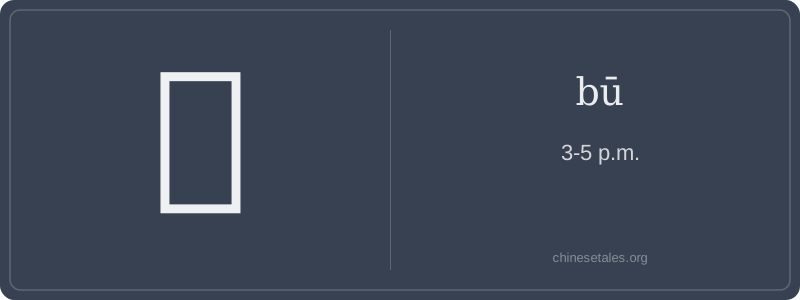
The earliest form of 晡 appears in Han dynasty clerical script — not oracle bone, but already highly stylized. Its left side 日 (rì, 'sun') anchors it firmly in timekeeping, while the right side 布 (bù, 'to spread') was originally a phonetic component, but look closer: the top strokes of 布 resemble the sweeping arc of the late-afternoon sun across the horizon, and the lower '巾' (jīn, 'cloth') evokes draping twilight. Over centuries, the character simplified: the upper '丿' and '一' of 布 fused into the clean '亠' + '父', and the whole right side compacted into a rhythmic, balanced 7-stroke unit — 11 strokes total, mirroring the 11th hour in the old system (if counting from midnight).
This visual evolution mirrors its semantic journey: from a concrete depiction of sunlight spreading westward (hence 布’s phonetic-semantic role) to a codified temporal marker. In the Book of Rites (Lǐjì), 晡時 is prescribed for the 'second tea offering' to ancestors — linking it to ritual punctuality. Later, Tang poets like Wang Wei used 晡 to evoke melancholy transition: '山光忽西落,池月漸東昇。 散發乘夕涼,開軒臥閒敞。 荷風送香氣,竹露滴清響。 欲取鳴琴彈,恨無知音賞。 感此懷故人,中宵勞夢想。' — though he didn’t use 晡 explicitly, the entire mood is 晡時: luminous, suspended, quietly decisive.
Imagine you’re in a quiet Song dynasty courtyard at the golden hour — the sun is low, casting long shadows across tiled roofs, and the air hums with the gentle clink of teacups. A scholar glances up, notes the light slanting just so across the western wall, and says, '晡時已至.' That’s 晡: not just '3–5 p.m.' as a clock reading, but a poetic, atmospheric *moment* — the third of the twelve traditional two-hour Chinese time divisions (shíchén), specifically the 'afternoon watch' when yang begins to wane and yin stirs. It carries weight, ritual, and seasonal rhythm — think temple bell tolls, herbal decoctions stirred at precise hours, or poets pausing mid-couplet to watch the light shift.
Grammatically, 晗 is almost never used alone. You’ll see it only in classical or literary contexts — always paired: 晡時 (bū shí, 'the hour of bū'), 晡刻 (bū kè, 'the bū quarter-hour'), or in compound time names like 申時 (shēn shí) — which *is* the official name for this period, while 晡 is its elegant, archaic synonym. Learners often mistakenly treat it like a modern noun ('I’ll meet you at bū') — but no, it doesn’t function like 点钟; it’s strictly part of fixed, formal time phrases, rarely in spoken Mandarin today.
Culturally, 晡 reflects how ancient China measured time by celestial observation, not mechanical precision. Confusing it with common time words like 下午 (xiàwǔ, 'afternoon') is a classic trap — 晡 is narrower (only 3–5 p.m.), more ceremonial, and vanishes outside classical texts or historical dramas. Even native speakers may pause to recall its tone (bū, not bǔ or bù) — that flat first tone signals its solemn, unchanging nature, like a sundial’s shadow holding still for exactly two hours.