晟
Character Story & Explanation
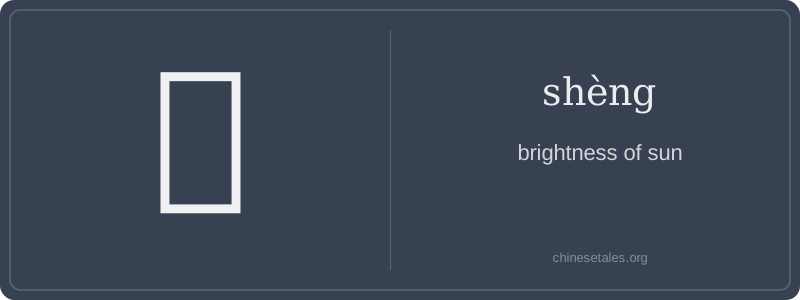
The earliest form of 晟 appears in Han dynasty clerical script, evolving from a fusion of 日 (rì, 'sun') and 成 (chéng, 'to complete, become'). Visually, it’s 日 stacked neatly above 成 — no simplification, no variant: this structure has held firm for over 2,000 years. The top 日 is unmistakable — a square sun with a horizontal stroke inside — while the bottom 成 resembles a kneeling figure () holding a weapon (戈), later stylized into today’s elegant curve-and-dot. There’s no oracle bone version; 晟 was likely coined later as a literary enhancement of 日, adding the idea of ‘fulfilled, perfected’ brightness — not just sunlight, but sunlight *at its zenith*.
This dual-layer meaning crystallized in the Tang and Song dynasties. In the 11th-century encyclopedia Taiping Yulan, 晟 appears in entries on ‘auspicious solar phenomena’ — eclipses interpreted as cosmic affirmations, not omens. Poets like Su Shi used it sparingly to evoke luminous clarity of mind, linking solar brilliance to sage-like wisdom. Crucially, its visual design reinforces its semantics: the sun (日) literally crowns the character 成 ('completion'), making it a glyphic metaphor — ‘the sun completes itself’ = ultimate, self-actualized radiance. That’s why it feels so solemn: it’s not illumination you observe — it’s illumination you *witness as destiny fulfilled*.
Think of 晟 (shèng) as the Chinese equivalent of a 'sunburst' emoji — not just light, but radiant, auspicious, almost ceremonial brightness. Unlike generic words for 'bright' like 亮 (liàng) or 明 (míng), 晟 carries poetic gravity: it’s the sun at its most majestic, unblinking and sovereign — like Apollo stepping fully into his chariot at high noon. It’s never used casually; you won’t see it on street signs or weather apps. Instead, it lives in names (especially given names), classical poetry, and formal inscriptions where grandeur and virtue are implied.
Grammatically, 晟 is almost exclusively a noun or adjective in literary contexts — never a verb, never in compound verbs like ‘to brighten’. You’ll find it in phrases like 晟光 (shèng guāng, 'radiant light') or 晟世 (shèng shì, 'a glorious era'), but never as a standalone predicate (*他晟* is ungrammatical). Learners sometimes try to substitute it for 明 in ‘tomorrow’ (明天 → *晟天*), which is a hard error — 晟 has zero temporal meaning. Its tone (4th) also trips people up: shèng rhymes with ‘sheng’ in ‘Shanghai’, not ‘sheng’ in ‘Shenzhou’ (which is 1st tone).
Culturally, 晟 appears in imperial-era texts describing enlightened reigns — think of how ‘halo’ implies sanctity in Renaissance art; 晟 does that for sunlight in Chinese cosmology. It’s also wildly popular in modern baby names (e.g., 李晟, Lǐ Shèng), precisely because it suggests brilliance *with moral weight*, not just IQ points. A common mistake? Assuming it’s interchangeable with 盛 (also shèng, meaning ‘prosperous’) — they share pronunciation and auspiciousness, but 盛 is earthly abundance; 晟 is celestial radiance.