昶
Character Story & Explanation
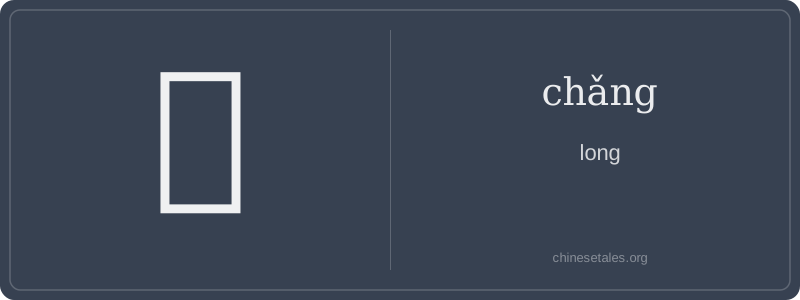
The earliest form of 昶 appears in Han dynasty seal script, not oracle bones — it’s relatively late-born. Visually, it fuses 日 (rì, 'sun') on the left with 永 (yǒng, 'eternal, flowing') on the right. The right side isn’t just decorative: 永 itself evolved from a pictograph of water flowing endlessly — three wavy strokes representing a stream, plus a dot and hook suggesting its source and continuation. In 昶, this 'eternal flow' is illuminated by the sun, creating a compound ideograph: 'sunlit eternity'. Over centuries, the 永 component simplified — its original five strokes condensed into the clean, balanced nine-stroke structure we see today: 日 + 永 → 昶.
This fusion reflects a core Daoist-Buddhist-literati ideal: luminosity that endures without obstruction. Classical sources like the Wen Xuan (Selections of Refined Literature) use 昶 to describe 'days of clear, unclouded governance', while Song dynasty poets paired it with 风 (wind) or 空 (sky) to evoke serene, boundless clarity. Crucially, its meaning never drifted toward 'length' in the mundane sense — it stayed rooted in light, time, and auspicious continuity, making it more philosophical than descriptive.
Think of 昶 (chǎng) as the Chinese equivalent of a 'sunlit hallway' — not just 'long' in duration, but long in *light*, in *clarity*, and in *unbroken expanse*. Unlike common words for 'long' like 长 (cháng), which measures physical length or time neutrally, 昶 evokes a poetic, almost celestial spaciousness: imagine sunlight streaming down an endless corridor at dawn — that’s the feeling. It’s not used for 'a long book' or 'a long wait'; instead, it appears in names, classical poetry, and formal writing to suggest enduring brightness, openness, or auspicious longevity.
Grammatically, 昶 is almost never a standalone verb or adjective in modern speech. You won’t say '今天很昶' — that’s ungrammatical. Instead, it functions primarily as a literary noun ('bright, expansive time') or as a name character (e.g., in given names like 李昶). When used adjectivally, it’s always embedded in compounds like 昶日 (chǎng rì, 'auspicious day') or 昶空 (chǎng kōng, 'vast sky'), never alone. Learners often mistakenly treat it like 长 and try to use it predicatively — a red flag that instantly marks non-native usage.
Culturally, 昶 carries imperial-era gravitas: it appears in Tang dynasty poetry and Ming-Qing stele inscriptions to describe benevolent, unobstructed reigns — 'the emperor’s bright and enduring virtue'. Its rarity today makes it feel like discovering a forgotten sonnet tucked inside a dictionary. And yes — you’ll almost certainly encounter it first on a friend’s ID card or wedding invitation, not in a textbook.