昴
Character Story & Explanation
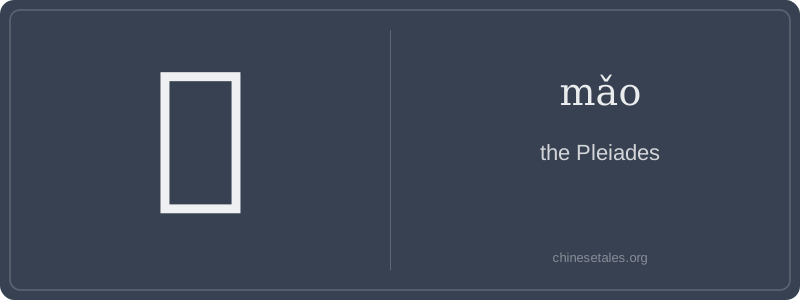
The earliest form of 昴 appears in Warring States bamboo slips as a stylized pictograph: a cluster of dots (stars) nestled above a simplified 'doorframe' shape (卯), later acquiring the 日 radical at the top during Han dynasty standardization. Oracle bone inscriptions don’t contain 昴 — it emerged later as astronomical observation deepened. The modern form crystallized by the Eastern Han: 日 (9th stroke, the final horizontal bar) crowns 卯 (which itself evolved from a glyph representing an open gate at dawn), visually anchoring the stars to the celestial vault — as if the sun rises *to witness* this stellar cluster each year.
This visual logic reflects ancient Chinese cosmology: the sun doesn’t rule the stars — it *attends* them. In the Shiji (Records of the Grand Historian), Sima Qian lists 昴宿 as the fourth lunar mansion, linking it to the metal element and the west. Its name even echoes in folklore: the 'Seven Sisters' of Western myth became the 'Six Stars' (六星) in early texts — later expanded to seven as observation sharpened. The 日 atop 卯 isn’t literal sunlight; it’s symbolic presence — the celestial bureaucracy assigning the Pleiades its official post in the heavenly administration.
Imagine you’re stargazing with a Chinese astronomer in ancient Luoyang — not with a telescope, but with a bronze ritual vessel and bamboo strips. She points to a tight cluster of stars shimmering like diamond dust, whispers 'Mǎo xīng' (the Pleiades), and traces the character 昴 in the air: 日 (sun/day) above 卯 (a phonetic component meaning 'dawn gate'). This isn’t just astronomy — it’s cosmology fused with timekeeping. In classical Chinese, 昴 names one of the Twenty-Eight Lunar Mansions, a celestial 'postal zone' used to track the moon’s monthly journey across the sky. It carries no verb or adjective function; it’s strictly a proper noun — always capitalized in meaning, never conjugated.
Grammatically, 昴 appears almost exclusively in compound nouns (e.g., 昴宿, 昴星团) or poetic phrases — never alone in modern speech. Learners sometimes mistakenly use it as a generic word for 'star', but that’s like calling the Big Dipper 'Ursa Major' in casual English — technically correct, but wildly out of place at the dinner table. You won’t hear it in HSK dialogues, textbooks, or subway announcements — only in classical poetry, astrological almanacs, or when a calligrapher signs a painting of the night sky.
Culturally, 昴 evokes quiet reverence: it marked the spring equinox in Zhou dynasty calendars and signaled the start of planting season. A common error? Confusing it with 卯 (mǎo, the 4th Earthly Branch) — same sound, same radical placement, but 卯 lacks the 日 on top and refers to time (5–7 a.m.) or zodiac (Rabbit year), not stars. Remember: if there’s a 日 looking up at the heavens, it’s starlight — not sunrise.