昳
Character Story & Explanation
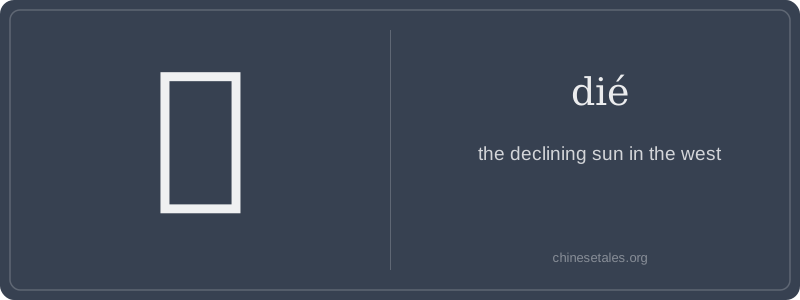
The earliest form of 昿 appears in bronze inscriptions (c. 1000 BCE) as a composite pictograph: a stylized sun (日) positioned above a simplified 'step' or 'platform' (失 — an early variant shape suggesting descent), visually capturing the sun descending behind a western horizon or ridge. Over centuries, the upper element stabilized as 日, while the lower evolved from 車-like forms into 失 (shī), though crucially, it’s *not* the modern character 失 ('to lose') — rather, it’s a phonetic-semantic compound where 失 provided both sound (shī → dié via tonal shift and dialectal evolution) and the idea of 'falling away'. By the Han dynasty, the structure solidified into today’s 日 + 失.
This character’s semantic journey mirrors China’s literary sensibility: from a concrete observation of solar position, it became a metaphor for dignified decline — think of aging sages, fading dynasties, or autumnal landscapes in Song dynasty poetry. The Shuōwén Jiězì (121 CE) defines it as 'rì xī yě' (the sun at its western point), confirming its directional precision. Interestingly, its rarity today isn’t due to obsolescence, but preservation — it was so perfectly evocative that poets kept it in their most refined arsenals, never letting it drift into slang or bureaucracy.
At first glance, 昳 (dié) feels like a poetic ghost — it’s not used in daily speech, and you won’t hear it on the subway or in HSK textbooks. Its core meaning — 'the declining sun in the west' — isn’t just astronomical; it evokes a specific, melancholy moment: that hush when light softens, shadows lengthen, and day yields to dusk. In classical Chinese, this wasn’t just description — it was emotional syntax. The setting sun carried connotations of waning power, gentle endings, or quiet reflection, often paired with words like 暮 (mù, 'dusk') or 夕 (xī, 'evening').
Grammatically, 昳 functions almost exclusively as a literary noun or adjective in fixed compounds — never standalone in modern speech. You’ll find it in classical allusions or poetic titles (e.g., 昳色 — 'the hue of the setting sun'), but never in 'I saw the sunset' (that’s 落日 luòrì). Learners sometimes mistakenly try to use it like 日 (rì, 'sun') or 晒 (shài, 'to sun-dry'), but 昿 has zero colloquial traction — it’s strictly a brush-and-ink character, alive only in calligraphy scrolls and Tang dynasty verse.
Culturally, 昳 reveals how deeply Chinese aesthetics link time, light, and feeling. Unlike English’s neutral 'sunset', 昳 embeds temporality *and* tone — it’s inherently lyrical, even elegiac. A common learner trap? Confusing it with 易 (yì, 'easy') due to visual similarity — but while 易 flows with ease, 昳 lingers with gravity. It’s not about brightness or heat, but about the *grace* of decline — a subtle but profound cultural valuing of gentle transitions over abrupt endings.