昱
Character Story & Explanation
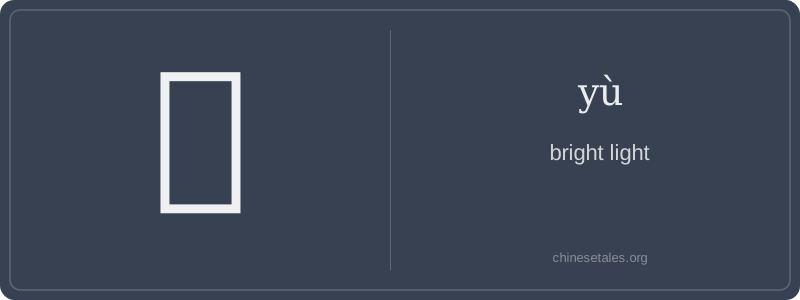
Oracle bone script had no direct precursor for 昱, but its earliest bronze inscription form (c. 1000 BCE) fused 日 (sun) above 立 (to stand upright) — not as separate strokes, but as a unified glyph suggesting the sun *rising into firm, commanding position*. By the Small Seal Script (Qin dynasty), the two components were clearly differentiated: 日 perched neatly on top of 立, each stroke refined and balanced. The nine strokes emerged deliberately: four for the sun’s square frame, then five for 立 — two short horizontal lines (the head), a long vertical (the body), and two angled legs. No extra dots or flourishes: every line conveys stability and elevation.
This visual logic shaped its meaning: not mere brightness, but *light that stands tall, authoritative, and enduring*. In the Shuōwén Jiězì (121 CE), Xu Shen defined 昱 as ‘daylight shining brightly’ (日光也), emphasizing its solar origin and intensity. By the Tang dynasty, poets used 昱 in paired forms (昱昱) to evoke luminous dignity — Li Bai wrote of ‘stars shining with celestial 昱’, linking it to cosmic order. Its enduring rarity in daily language underscores its reserved status: this isn’t streetlight brightness — it’s the kind that crowns emperors and illuminates classics.
昱 (yù) isn’t just ‘bright light’ — it’s *radiant authority*. In Chinese, brightness isn’t neutral; it carries moral and cosmic weight. Think of the sun (日) as heaven’s sovereign — and 昱 is that sovereign *shining with deliberate, dignified brilliance*. It evokes clarity, auspiciousness, and quiet mastery — not blinding glare, but the steady glow of a wise ruler or a well-ordered cosmos. You’ll rarely hear it in casual speech; it lives in names, classical poetry, and formal inscriptions where luminosity signals virtue or destiny.
Grammatically, 昱 functions almost exclusively as a noun or adjective in literary or proper-noun contexts — never as a verb or standalone predicate. Learners often mistakenly try to use it like ‘bright’ in ‘the room is bright’ (which is 亮 liàng). But 昱 doesn’t describe ambient light; it names *a quality of luminous excellence*: ‘his talent shines brightly’ becomes 他才华昱昱 (tā cáihuá yù yù), using the reduplicated form for poetic emphasis — not ‘he is yù’, but ‘his brilliance *is昱*’. It’s syntax-bound: you’ll see it in compound adjectives (昱昱), surnames (Yù family), or given names (e.g., 李昱晨 Lǐ Yùchén — ‘morning light that shines with purpose’).
Culturally, 昱 reveals how deeply Chinese thought links light with ethical clarity and celestial mandate. Confucian texts associate radiant imagery with sage-kings whose virtue ‘illuminates the realm’. Misusing 昱 as a general synonym for ‘bright’ sounds archaic or comically inflated — like calling a desk lamp ‘solar radiance’. Also, its 9-stroke structure (with the 日 radical atop 立) subtly echoes ‘sun standing upright’ — a visual metaphor for unshakeable, vertical luminosity, not flickering or diffuse light.