昄
Character Story & Explanation
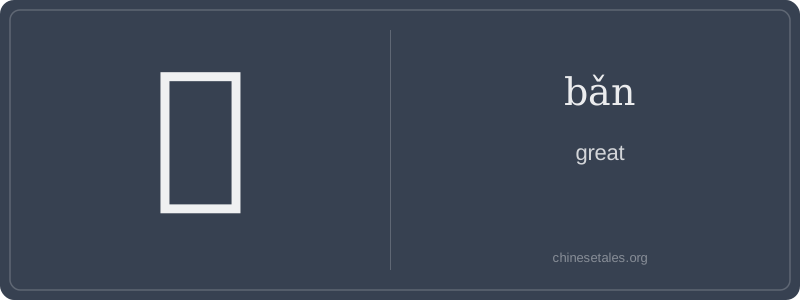
The earliest form of 昄 appears on Western Zhou bronze inscriptions as a highly stylized pictograph: a large, upright human figure with exaggerated arms raised wide and feet planted firmly — not dancing, but embodying cosmic centrality and sovereign presence. Over centuries, the arms simplified into two horizontal strokes (一), the torso became a vertical line (丨), and the legs fused into a broad, stable base resembling the radical 攴 (pū, 'to strike' — though here it’s purely structural). By the Small Seal Script era, the character had crystallized into its modern shape: two horizontal lines over a vertical stroke anchored by a wide, grounded bottom — visually echoing the idea of 'standing great' rather than 'being big.'
This visual stability directly shaped its meaning: 昄 never meant 'large in dimension' but 'supreme in moral authority' — the kind of greatness conferred upon sage-kings like Yao and Shun in the *Book of Documents*. In the *Zuo Zhuan*, it appears only in ritual oaths ('May Heaven witness our 昄 vow'), where it conveys solemn, binding magnitude. Its rarity today isn’t decline — it’s preservation: the character remains unchanged, fossilized in dignity, precisely because its meaning was too sacred to dilute.
Think of 昄 as Chinese mythology’s version of the 'Great' in 'The Great Gatsby' — not about size or volume, but about profound, almost mythic stature: moral grandeur, cosmic significance, or ancestral reverence. It’s not an everyday word like 大 (dà, 'big'); it’s reserved for sacred, classical, or poetic contexts — like calling Confucius ‘Great Master’ (大師) versus invoking 昄師 (bǎn shī), a rare, archaic honorific implying transcendent wisdom.
Grammatically, 昄 is almost never used alone. It appears only in fixed, literary compounds — always as the first character, and almost always before nouns denoting people, virtues, or natural forces (e.g., 昄德 bǎn dé, 'great virtue'). You’ll never say *‘This mountain is 昄’ — it doesn’t function as a predicate adjective. Learners mistakenly try to substitute it for 大 or 偉 (wěi, 'great' in modern political contexts), which instantly sounds archaic, jarring, or even comically inflated — like describing your coffee as 'the Great Brew.'
Culturally, 昄 carries the hush of ancient bronze inscriptions and the weight of Zhou dynasty ritual texts. It’s absent from spoken Mandarin and HSK because it’s functionally obsolete outside classical study, calligraphy, or ceremonial titles. A common trap? Seeing its ‘ban’ sound and assuming it relates to 板 (bǎn, 'board') — no connection whatsoever. Its true home is in the quiet corners of pre-Qin literature, not the bustling street.