昃
Character Story & Explanation
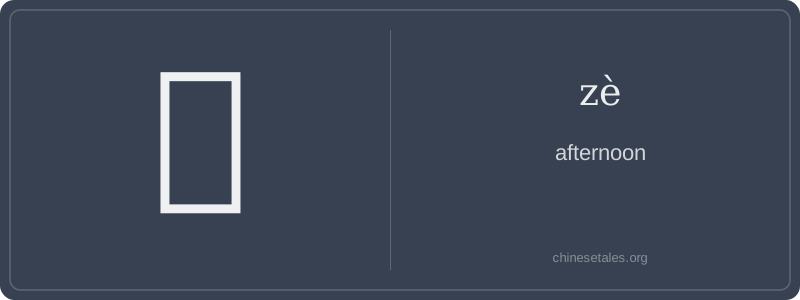
The earliest form of 昃 appears in bronze inscriptions as a vivid pictograph: a sun (日) drawn above a slanted line or diagonal stroke—representing the sun’s unmistakable westward slant at mid-afternoon. Over centuries, the slant evolved into the right-side component 仄: first a simple oblique dash, then stylized into three strokes (丨丶一) mimicking the sun's angular descent. The left 日 radical remained stable—anchoring the meaning in celestial observation. By the Small Seal Script (c. 200 BCE), 昃 had crystallized into its modern eight-stroke shape: 日 + 仄, visually echoing the sun caught mid-tilt, frozen in calligraphic gravity.
This visual logic directly shaped its semantic journey. In early texts like the Shu Jing (Book of Documents), 昃 wasn’t just 'afternoon'—it marked the turning point: the moment yang energy peaks and yin begins its quiet rise. Confucius praised Duke Zhou for governing diligently 'until 日昃'—implying moral stamina through the day’s pivotal shift. Even today, 昃 carries this weight of transition: not mere clock-time, but cosmic punctuation—the sun’s graceful surrender to twilight.
Think of 昃 (zè) as the Chinese equivalent of 'the witching hour'—but for afternoon. Not the lazy, sun-dappled midday of Western idylls, but the precise, almost solemn moment when the sun begins its visible descent—around 1–3 p.m., when shadows tilt westward and ancient timekeeping shifted from 'yang peak' to 'yin ascent.' It’s a literary, formal word—rare in speech, common in classical texts, poetry, and ceremonial contexts (e.g., imperial edicts or wedding vows), much like how English uses 'verily' instead of 'really.'
Grammatically, 昃 functions almost exclusively as a noun or temporal noun adjunct—not a verb or adjective—and nearly always appears in fixed phrases: 日昃 (rì zè, 'sun tilts'), 不昃 (bù zè, 'never tilts' — metaphor for unwavering virtue), or in compound time markers like 晡昃 (bū zè, 'late afternoon'). You’ll never say 'I ate at zè'—it doesn’t stand alone like 'afternoon' in English; it must be anchored: 日昃之时 (rì zè zhī shí, 'at the time when the sun tilts'). Learners often mistakenly treat it as a free-standing synonym for 'afternoon,' leading to unnatural phrasing.
Culturally, 昃 embodies the ancient Chinese skywatcher’s precision: no clocks, just the sun’s arc across the heavens. In the Book of Documents, rulers are admonished not to neglect duties 'until 日昃'—a subtle reminder that authority wanes with light. Modern learners’ biggest trap? Confusing it with 仄 (zè), which shares the same pronunciation and radical but means 'oblique tone' or 'unbalanced' in poetic meter—a homophone landmine!