旽
Character Story & Explanation
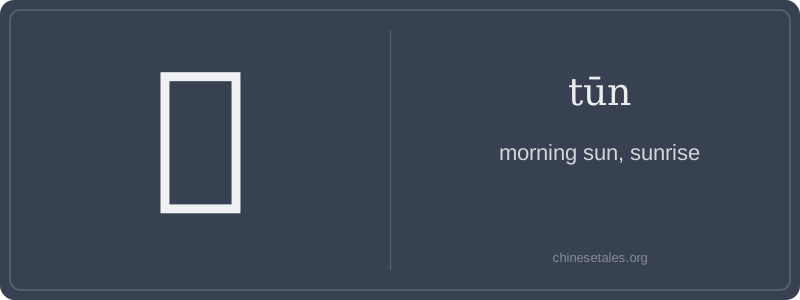
The character 旽 has no oracle bone or bronze script form — it’s a late creation, first appearing in the Yunhai jingyuan (c. 978 CE), a Song-dynasty rhyme dictionary. Its structure is deliberately evocative: the left radical is 日 (rì, 'sun'), anchoring its solar essence; the right component is 屯 (tún), which originally depicted sprouting seeds — a pictograph of a plant pushing up through soil. Over centuries, 屯 simplified and stylized, but its meaning — 'to gather', 'to emerge', 'to begin' — remained. So 旽 isn’t just 'sun'; it’s 'sun emerging', 'light gathering at daybreak' — a visual metaphor made literal in ink.
This semantic fusion — sun + emergence — gave 旽 its singular nuance. Unlike 晨 (chén, 'morning') which marks time, or 曙 (shǔ, 'daybreak') which emphasizes light breaking through darkness, 旽 centers on the *sun itself as an active, rising presence*. Classical poets used it sparingly but powerfully: in a Ming-era poem, '山衔旽色' (shān xián tūn sè) — 'the mountains cradle the dawn-color' — where 旽 suggests warmth radiating *from* the sun, not just ambient light. Its form remains unchanged since the Song dynasty, a testament to how perfectly its components capture that single, suspended moment when night yields to light.
Let’s be honest: 旽 (tūn) is a quiet superstar — not flashy like 日 (rì, 'sun') or common like 早 (zǎo, 'early'), but deeply poetic. It doesn’t mean just 'sun' — it means the *morning sun rising*, that tender, golden moment when light first spills over the horizon and everything feels new. Native speakers don’t use it in daily chatter (you won’t hear it ordering coffee), but it appears in classical poetry, names, and refined literary descriptions — think of it as the haiku syllable of Chinese characters: compact, luminous, emotionally precise.
Grammatically, 旽 is almost always a noun or a noun modifier, rarely a verb. You’ll see it in phrases like '旽光' (tūn guāng, 'morning sunlight') or '旽色' (tūn sè, 'dawn hue'). Crucially, it *cannot* stand alone as a subject or predicate without context — saying '旽很美' sounds unnatural; instead, you’d say '旽光很美' or '晨旽很美'. Learners often mistakenly treat it like 日 or 陽 (yáng) and drop it into casual sentences — a subtle but telltale sign of non-native phrasing.
Culturally, 旽 carries wistful, lyrical weight — it evokes quiet reverence for beginnings, renewal, and fragile beauty. In modern usage, it’s most alive in personal names (e.g., a baby named 旽宇, Tūn Yǔ — 'Dawn Universe') and calligraphic art. A common mistake? Pronouncing it as tún (like 'tun') — no, it’s tūn, with a flat, high tone, echoing the stillness of dawn before birdsong begins.