旼
Character Story & Explanation
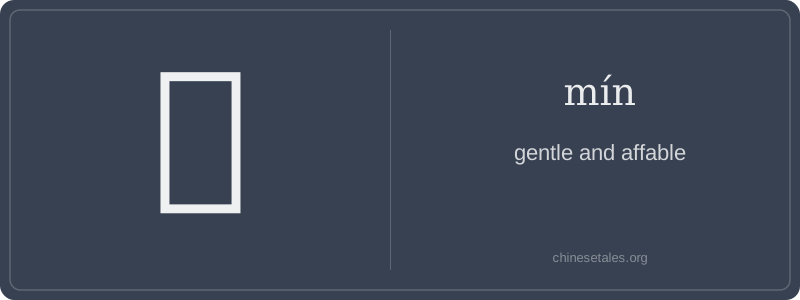
The character 旼 first appeared in late Han dynasty steles and early clerical script — not oracle bones or bronze inscriptions, which is itself telling: it’s a *constructed* character, not an ancient pictograph. Its form merges 日 (rì, ‘sun’) on the left and 文 (wén, ‘culture’, ‘refinement’, ‘pattern’) on the right. Visually, it’s elegant symmetry: the sun radiating order, not heat — calm light meeting cultivated grace. Over centuries, the clerical script’s sweeping curves hardened into the clean, balanced structure we see today: a vertical stroke anchoring the sun’s rectangle, while 文’s slanting strokes soften into poised elegance.
This deliberate fusion reflects its meaning’s origin: scholars in the Han and Tang dynasties coined such characters to articulate subtle Confucian virtues — here, the ideal of ‘civilized warmth’. Unlike natural words like 和 (harmony), 旼 was crafted to describe the *aesthetic quality* of benevolent presence. It appears in Tang-era poetry describing sages’ countenances and Song dynasty epitaphs praising officials whose governance felt ‘sunlit and humane’. The sun isn’t blazing; it’s rising gently — and 文 isn’t rigid ritual, but harmonious patterning. Together, they make kindness visible, luminous, and deeply cultural.
ʻ旼ʼ (mín) is a rare, poetic character that evokes a very specific kind of gentleness — not passive softness, but warm, open-hearted affability: the kind that puts strangers at ease with a smile and a slight bow. It’s deeply Confucian in spirit, capturing the ideal of rén (benevolence) expressed through effortless, unforced kindness — less ‘being nice’ and more ‘radiating welcome’. You won’t hear it in daily speech; it lives in names (especially given names for girls), classical poetry, and formal inscriptions where tone and moral resonance matter more than efficiency.
Grammatically, 旼 functions almost exclusively as an adjective — but crucially, it *never* stands alone. It always appears in compounds (like 旼然 or 旼穆) or as part of a two-character personal name (e.g., 林旼雅). Learners sometimes mistakenly try to use it like common adjectives (e.g., *‘tā hěn 旼’*), but that construction is ungrammatical and unheard of — it’s not a standalone descriptive word like 好 or 温柔. Its grammar is ‘name-classical’: ornamental, not functional.
Culturally, 旼 reveals how Chinese values encode moral qualities in aesthetic form: its structure combines ‘sun’ (日) and ‘civilized/ritual’ (文), suggesting benevolence illuminated by culture — kindness made luminous through cultivation, not instinct. A common learner trap is overestimating its frequency; seeing it in a name doesn’t mean it’s usable elsewhere. It’s a character you admire, not deploy — like finding a hand-engraved seal in a modern office: beautiful, meaningful, and utterly out of place on your email signature.