旻
Character Story & Explanation
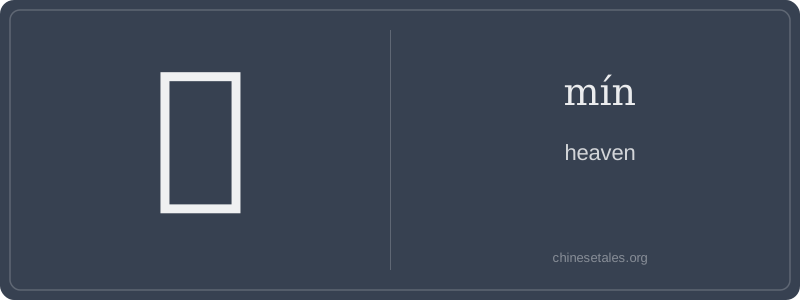
The earliest form of 旻 appears on late Shang oracle bones and Zhou bronze inscriptions as a stylized sun (日) above a simplified figure or pattern resembling 文 (wén) — originally depicting ritual inscriptions or cosmic order marks. Over centuries, the lower component evolved from a pictograph of interlaced threads or ceremonial script into the standard 文 radical. The upper 日 remained clear, anchoring the meaning to celestial light. By the Qin small seal script, the two parts fused into a balanced, upright structure: sun above culture — heaven as both luminous and meaningful. Its strokes stabilized early, with no simplification in the PRC reform, preserving its classical integrity.
This visual logic shaped its semantic journey: from ‘sunlit sky’ → ‘the ordered, benevolent heavens’ → ‘compassionate, watchful heaven’ in Confucian and Daoist thought. In the Classic of Poetry (Shījīng), ‘旻’ opens three ‘Lamentation Odes’ (《小雅·旻天》), where rulers appeal to ‘Mín Tiān’ — not as distant deity, but as a grieving, ethical force responding to human virtue or failure. The character’s quiet elegance mirrors this duality: visually calm (no aggressive strokes), semantically deep (not mere atmosphere, but moral presence). Even today, when a temple plaque reads ‘昊旻垂佑’, it invokes heaven not as power, but as tender, literate grace.
旻 (mín) is a poetic, literary word for 'heaven' — not the everyday sky (tiān 天), nor the bureaucratic celestial realm (tiān 廷), but heaven as vast, serene, compassionate, and slightly mournful. Think of it as heaven seen through the eyes of a Tang dynasty poet gazing at dusk: quiet, boundless, gentle yet solemn. It carries emotional weight — often evoking reverence, melancholy, or cosmic harmony. You’ll almost never hear it in casual speech; it lives in classical poetry, formal inscriptions, and names.
Grammatically, 旻 functions as a noun and rarely appears alone. It’s usually paired in compounds like 旻天 (mín tiān) or in fixed phrases such as ‘昊旻’ (hào mín). Unlike 天, it doesn’t take aspect markers (了, 过) or verbs — you won’t say *旻了* or *旻过*. Also, avoid using it as a subject in modern spoken sentences (e.g., ❌‘旻很蓝’); that’s unnatural. Instead, it appears in elevated contexts: ‘承旻之德’ (to receive heaven’s virtue) or ‘仰观旻宇’ (gazing up at the boundless heavens).
Culturally, 旻 subtly reflects ancient Chinese cosmology: heaven isn’t just space — it’s morally active, responsive, even sorrowful. In the Book of Songs, ‘旻’ appears in elegiac odes mourning dynastic decline — implying heaven watches with pity. Learners often misread it as ‘min’ (like ‘minute’) and confuse it with 民 (mín, ‘people’) or 明 (míng, ‘bright’). Remember: 旻 has no ‘sun’ or ‘moon’ — its top is 日 (sun), but the bottom is 文 (wén), not 民 or 月. That 文 hints at culture, writing, and cultivated reverence — heaven as a moral text written across the sky.