斮
Character Story & Explanation
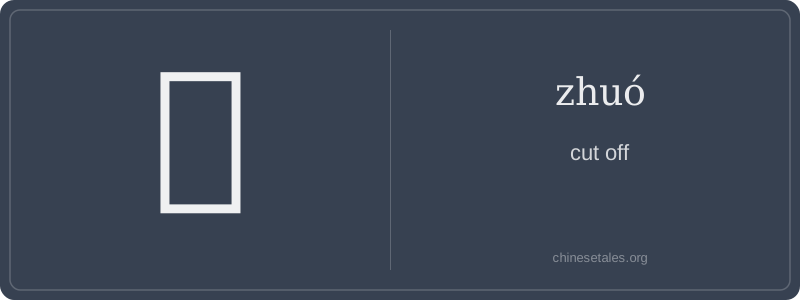
The earliest form of 斮 appears on Warring States bamboo slips as a composite glyph: on the left, a variant of 斤 (jīn), an axe-head radical; on the right, a simplified depiction of a person (人) with an exaggerated neck or torso — clearly marked for removal. Over time, the person evolved into the lower component 釆 (biàn), originally meaning ‘to distinguish by sight’, but here repurposed phonetically and visually to suggest ‘a body identified for severing’. The axe remained dominant — no gentle knife, no subtle blade, just raw, authoritative cleavage.
This visual logic hardened into moral grammar: in the Zuo Zhuan, 斮 appears in accounts of punitive executions — ‘斮叛臣之足’ (‘cut off the feet of the rebel minister’) — where the act served both punishment and symbolic purification. By the Tang dynasty, poets like Du Fu used 斮 metaphorically: ‘斮愁为缕’ (‘chop sorrow into threads’), turning violence into poetic fragmentation. The character never softened; its very structure refuses ambiguity — if you see 斮, something irrevocable has ended.
‘斮’ (zhuó) isn’t just ‘cut off’ — it’s the visceral, decisive severing of something vital: a limb, a lineage, a rebellion. In classical Chinese, it carries the weight of ritual justice or battlefield finality — think executioner’s axe, not kitchen knife. It’s never used for casual cutting (like 切 or 削); its tone is grave, archaic, and morally charged. You’ll almost never hear it in modern speech — but you’ll see it in historical novels, opera libretti, or scholarly essays quoting ancient texts.
Grammatically, 斮 functions as a transitive verb, always requiring a direct object (e.g., 斮其首 — ‘cut off his head’). Unlike common verbs, it rarely appears in compound words with aspect markers (了, 过) or complements (掉, 断) — its bare form *is* the completion. Learners sometimes wrongly insert 斮 into modern contexts like ‘斮菜’ (‘chop vegetables’), which sounds absurdly violent to native ears — imagine shouting ‘BEHEAD THE CABBAGE!’ at dinner.
Culturally, 斮 reveals how Chinese semantics encode moral gravity into verbs: the same physical action (cutting) splits into dozens of characters — each calibrated by tool, intent, target, and consequence. Confusing 斮 with milder verbs erases centuries of rhetorical precision. It’s not obsolete — it’s reserved, like using ‘decapitate’ instead of ‘cut’ in English: technically correct, but only when the stakes are life, law, or legend.