斫
Character Story & Explanation
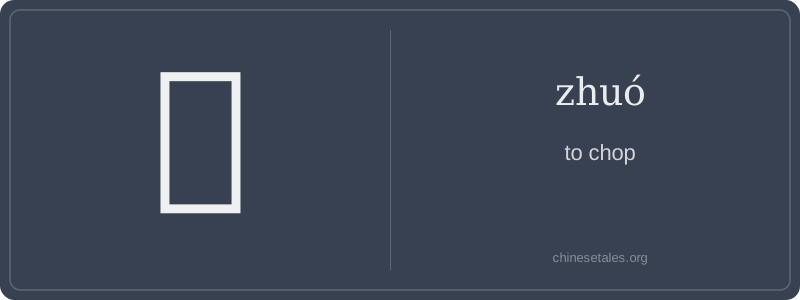
The earliest form of 斫 appears in bronze inscriptions as a combination of two clear elements: 斤 (a stylized axe head, drawn with a sharp blade and curved haft) and 石 (shí, ‘stone’), depicted as three stacked pebbles. Over centuries, 石 simplified and rotated, eventually merging into the lower right component — now written as 丶 + 一 + 丿, resembling a falling chip of stone. The top-left 斤 remained iconic: a bold, angular axe poised mid-swing. By the seal script era, the character had crystallized into its modern nine-stroke structure — every line echoing the tension of impact: the axe descending, the material yielding, the chip flying.
This visual drama shaped its semantic journey. In the *Shuōwén Jiězì* (121 CE), Xu Shen defined 斫 as ‘to cut with an axe’, emphasizing force and instrument. But by the Warring States period, it gained nuance: Zhuangzi used 斫 in the famous story of the woodcarver Qing, who ‘could 斫 wood so perfectly his chisel left no trace’ — transforming 斫 from brute force into sublime mastery. Later, poets like Li Bai wielded it metaphorically: 斫月 (zhuó yuè, ‘chop the moon’) expressed defiant ambition. Its shape never changed, but its soul deepened — from physical cleaving to the disciplined removal of illusion, excess, or falsehood.
Imagine a master woodcarver in a misty Jiangnan workshop, standing before a gnarled piece of huanghuali wood. With one precise, downward stroke of his heavy axe — *zhuó* — he cleaves away the rough outer layer, revealing smooth, golden grain beneath. That single, decisive action is 斫: not just 'to chop', but to chop *with purpose, skill, and finality*. It’s not the frantic hacking of a beginner or the casual cutting of daily life — it’s intentional, often artistic or ritualistic, and carries weight. You’ll rarely hear it in modern spoken Mandarin; it lives in classical texts, poetry, and formal compound words.
Grammatically, 斫 functions almost exclusively as a transitive verb, always taking a direct object (e.g., 斫木 ‘chop wood’, 斫琴 ‘carve a zither’), and it *never* appears alone in speech. Learners sometimes mistakenly use it like 切 (qiē) or 砍 (kǎn), but that’s like using ‘hew’ instead of ‘cut’ in English — technically correct, but jarringly archaic and contextually wrong. You won’t say ‘I’ll 斫 this apple’ — you’d say ‘I’ll cut it’. Instead, you might read in a Tang poem: ‘斫却月中桂,清光应更多’ — ‘If we chop down the cassia tree in the moon, its light will shine even brighter.’
Culturally, 斫 evokes craftsmanship, restraint, and Daoist or Confucian ideals of precision — removing only what obstructs true form. A common error is overusing it in writing to sound ‘literary’, which backfires: native readers sense artificiality. Also, don’t confuse it with 斤 (jīn), the radical meaning ‘axe’ — 斫 *is* the act *of* wielding that axe, not the tool itself. Its power lies in its scarcity: precisely because it’s absent from HSK and everyday talk, its appearance signals gravity, artistry, or antiquity.