攰
Character Story & Explanation
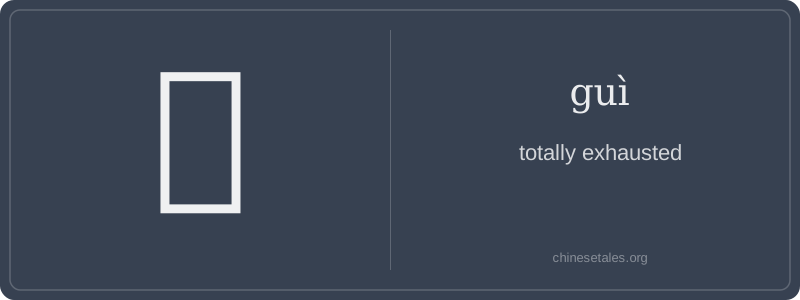
Oracle bone inscriptions show no direct precursor to 攰, but its earliest attested form appears on Warring States bamboo slips as a complex glyph combining two key elements: the left side () — a highly stylized, doubled ‘bent arm’ or ‘collapsed limb’ — and the right side (支), meaning ‘to support’ or ‘branch’, here used phonetically. Over centuries, the left side simplified from two distinct bent strokes into the modern , while 支 retained its shape but lost its original semantic role — becoming purely phonetic (its Middle Chinese pronunciation *kwej* closely matches guì). By the Han dynasty, the character had stabilized into its current 12-stroke form, visually echoing human collapse: arms bent inward, body unmoored, support failing.
The meaning evolved precisely along those lines: early uses in texts like the *Shuōwén Jiězì* (c. 100 CE) define it as ‘extreme exhaustion to the point of collapse’, emphasizing physiological failure rather than mere discomfort. It appears in Du Fu’s poems describing refugees ‘疲攰不能行’ (too exhausted to walk), and in the *Jīn Píng Méi*, where maidservants are described as ‘攰卧于廊下’ (collapsed, prostrate on the veranda). The character’s visual architecture — limbs folding inward, support (支) rendered ineffective — became inseparable from its semantic core: exhaustion so complete, the body abandons upright posture altogether.
Let’s be real: 攰 (guì) isn’t just ‘tired’ — it’s the linguistic equivalent of collapsing face-down onto your keyboard after pulling an all-nighter while arguing with a printer, your Wi-Fi, and your life choices. It means *totally, utterly, spiritually drained* — a state beyond fatigue, closer to existential depletion. In classical Chinese, it carried poetic weight; today, it’s rare in speech but appears in literary or emphatic contexts, often as a standalone adjective before nouns (e.g., 攰极了) or in fixed expressions like 疲攰 (pí guì), where it intensifies exhaustion.
Grammatically, 攰 behaves like a stative verb/adjective: it rarely takes aspect markers (no 攰了, 攰过), and almost never stands alone as a predicate without reinforcement — you’ll almost always see it paired (疲攰, 劳攰) or modified (累得攰, ‘so tired you’re done’). Learners sometimes mistakenly use it like 累 (lèi) — but that’s like swapping ‘exhausted’ for ‘done in’ and expecting the same emotional gravity. Also, it’s *never* used in formal writing or business emails — think of it as the character you’d scribble in a diary entry at 3 a.m., not in a WeChat group announcement.
Culturally, 攰 reflects a deeply embodied Chinese understanding of energy (qì) — not just physical weariness, but depletion of vital spirit. You’ll find it in Tang dynasty poetry describing scholars worn thin by imperial exams, or in Ming-Qing vernacular fiction portraying servants collapsing under relentless duty. A common mistake? Confusing its top component () with ‘hand’ or ‘person’ — it’s actually a stylized depiction of *bent limbs*, not an active gesture. That visual tells you everything: this isn’t ‘I’m tired’ — it’s ‘my body has folded itself into surrender.’