攮
Character Story & Explanation
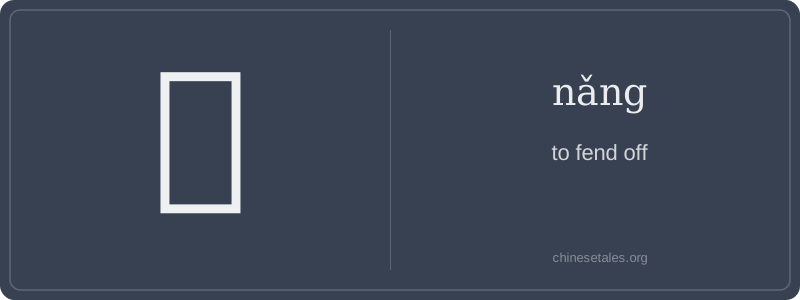
The earliest trace of 攮 appears not in oracle bones, but in late Warring States bronze inscriptions — a rare, dynamic glyph showing a hand (扌) gripping a curved, bladed tool (the right side, now written as 傍 + 刀 + 丶) angled sharply *away* from the body, with strokes suggesting recoil and redirection. Over centuries, the blade morphed into the complex right-hand component (旁 + 刀 + 丶), while the left 扌 radical anchored its manual, embodied nature. By the Song dynasty, the 25-stroke form stabilized — every stroke echoing tension: the sharp turn of the knife-like stroke, the downward press of the final dot, the crowded density reflecting the split-second decision it names.
This visual urgency shaped its meaning: classical texts like the *Jin Ping Mei* use 攮 almost exclusively for fending off physical threats — a servant 攮开突然扑来的猫, a scholar 攮开醉汉伸来的手. Its semantic core never abstracted; unlike 推 or 拒, it retained its martial-physical DNA. Even today, native speakers intuitively associate 攮 with *contact during motion* — not static blocking, but dynamic redirection. The 25 strokes aren’t just complexity; they’re choreography frozen in ink.
Imagine a Ming dynasty martial arts master in a rain-slicked courtyard, back pressed against a crumbling wall, three bandits lunging forward with rusted knives — and with one swift, low sweep of his forearm, he doesn’t strike *them*, but *deflects* their blades sideways, twisting their momentum into empty air. That’s 攮 (nǎng): not a punch, not a slash, but the precise, almost defensive *fending off* — a controlled, directional push-away using the arm or hand to neutralize force without escalation. It’s visceral, physical, and deeply situational: you 攮 a blow, a branch, a grasping hand — never an abstract idea or a person directly.
Grammatically, 攮 is almost always a transitive verb taking a concrete, immediate object — usually something coming *toward* the subject (a swing, a lunge, a falling object). You’ll rarely see it in isolation; it thrives in compound verbs like 攮开 (nǎng kāi, 'fend off and open space') or as part of tight action sequences: '他急忙攆开那根扫来的竹竿' (He hastily fended off the bamboo pole sweeping at him). Learners mistakenly treat it like 打 (dǎ, 'hit') or 推 (tuī, 'push') — but 攮 implies contact *in motion*, resistance *against incoming force*, and often a slight rotational or glancing quality. No passive voice, no abstract nouns — if you can’t *feel* the trajectory of what’s being deflected, you’re likely misusing it.
Culturally, 攮 lives in wuxia novels, opera stage combat, and dialectal speech (especially northern Mandarin), where precision of bodily response carries moral weight: to 攮 is to choose restraint over retaliation, control over chaos. It’s absent from formal writing and HSK lists precisely because it’s too vivid, too kinetic — a character that breathes only in the heat of the moment. Mistake it for 推, and you erase the artistry; confuse it with 挡 (dǎng), and you lose the active, deflective arc.