揽
Character Story & Explanation
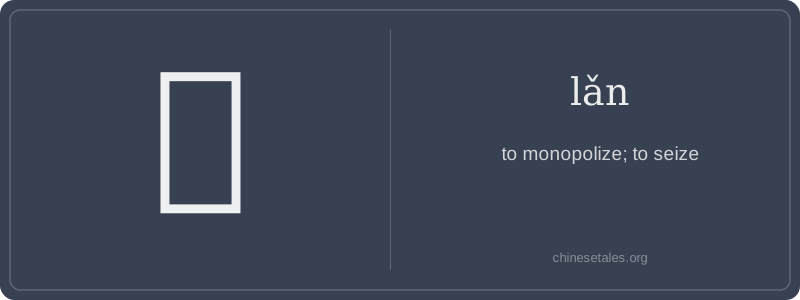
The earliest form of 揽 appears in seal script as a combination of 扌 (hand radical) and 敛 (liǎn, 'to gather, collect'), which itself evolved from a pictograph of hands drawing something inward toward the body — like pulling cloth tight or gathering grain into a basket. Over time, the right side simplified from 敛 to 览 (originally depicting eyes scanning a platform), but crucially, the left-hand radical 扌 remained dominant, anchoring the meaning in physical agency. By the Han dynasty, the shape stabilized into today’s 12-stroke form: three strokes for the hand (扌), then nine more forming the right component — a visual echo of 'reaching out and pulling in decisively'.
This evolution reflects a semantic deepening: from simple 'gathering' (like harvest) to 'taking exclusive possession'. In classical texts like the Book of Rites, 揽 appears in contexts describing ritual control — e.g., 'the elder must 揽礼 (lǎn lǐ) — oversee and regulate rites'. By the Tang dynasty, poets used it metaphorically: Du Fu wrote of mountains '揽秀' (lǎn xiù, 'seizing beauty'), transforming physical grasping into aesthetic mastery. The character’s enduring tension — between hand and eye, force and refinement — makes it a quiet powerhouse in formal Chinese.
Think of 揽 (lǎn) as the 'grab-and-hold-tight' character — not gentle like 拿 (ná, 'to hold'), nor casual like 拿起 (ná qǐ, 'to pick up'). It’s forceful, deliberate, and often slightly negative: to seize control, monopolize attention, or take over something that wasn’t yours to begin with. You’ll rarely see it in daily chit-chat; instead, it appears in formal writing, political commentary, or literary critique — like 揽权 (lǎn quán, 'to usurp power') or 揽胜 (lǎn shèng, 'to take in scenic views', a poetic exception where it’s neutral and elegant).
Grammatically, 揽 is almost always transitive and pairs with abstract nouns (power, fame, blame, scenery) — never concrete objects like 'a book' or 'a cup'. Learners often wrongly use it like 拿 or 抓, but 揽 *requires* an object with weight: social influence, responsibility, or prestige. Also, it’s nearly always in compound words — you won’t find it solo in modern speech.
Culturally, 揽 carries subtle moral gravity: 揽功 (lǎn gōng, 'to claim credit') implies ethical failure, while 揽过 (lǎn guò, 'to shoulder blame') signals rare integrity. A classic mistake? Confusing it with 览 (lǎn, 'to view') — same sound, totally different radical and meaning. Remember: 扌 = hand action; 罒 = eye action. One grabs power, the other scans a document.