攐
Character Story & Explanation
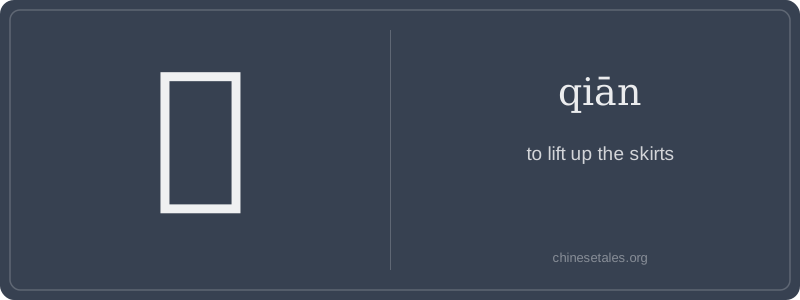
The earliest form of 攐 appears in late Warring States bamboo slips (c. 3rd century BCE), where it’s written with a left-hand ‘hand’ radical (扌) and a right-side component resembling 乾 (qián, ‘dry’ or ‘heaven’ — from the Yijing). That right side wasn’t phonetic coincidence: 乾’s ancient pronunciation was close to *kʰrən*, which morphed into qiān, matching 攐’s reading. Visually, the character fused the idea of ‘hand + upward/dry movement’ — dryness implying cleanliness, and upward motion echoing the skirt-lifting gesture to keep fabric clear of damp ground.
By the Han dynasty, 攐 stabilized into its current shape, appearing in texts like the *Shuōwén Jiězì* (121 CE) as ‘to raise one’s lower garment’. It appears in Tang poetry describing courtesans ascending stairs — ‘lift skirt, ascend, pause’ — and in Ming dynasty novels where heroines cross streams. Interestingly, its rarity increased precisely because it *worked too well*: once established as the canonical term for this refined gesture, it needed no synonyms — and thus faded from daily use as clothing styles changed. The character’s visual quietude — balanced, upright, uncluttered — mirrors the very poise it describes.
Let’s get real: 攐 (qiān) is a linguistic fossil — a character so rare and specific that most native speakers haven’t used it since their high school classical Chinese exam. Its core meaning is vividly physical: ‘to lift up one’s skirt’ — not in a modern slang sense, but as a precise, dignified gesture of modesty or practicality in pre-modern China. Think of a woman crossing a muddy path or stepping into a sedan chair: she’d gently raise the hem to avoid soiling her robes. This isn’t about fashion — it’s about propriety, movement, and embodied etiquette.
Grammatically, 攐 functions almost exclusively as a transitive verb, always paired with an object like 裙 (qún, skirt), 衣 (yī, garment), or 袍 (páo, robe). You won’t find it in casual speech or contemporary media; it lives in classical poetry, historical novels, and scholarly annotations. Learners often misread it as a variant of 扳 (bān, ‘to pull’) or 拎 (līn, ‘to lift by handle’) — but 攐 carries no mechanical force; it’s light, controlled, and culturally coded. Also beware: it’s *not* interchangeable with 提 (tí, ‘to lift’) — 提 implies upward motion of something held, while 攐 specifically means lifting fabric *from below*, along the body’s vertical axis.
Culturally, this tiny action reveals volumes: in Confucian-influenced dress codes, exposing ankles was taboo for women, so lifting skirts just enough — no more, no less — became a silent language of restraint and awareness. Modern learners sometimes overuse it trying to sound ‘literary’, but natives hear it as deliberately archaic, even theatrical — like quoting Shakespeare mid-sentence. The biggest trap? Assuming it’s related to ‘pulling’ because of the hand radical. Nope — it’s about *elevation with grace*, not traction.