攉
Character Story & Explanation
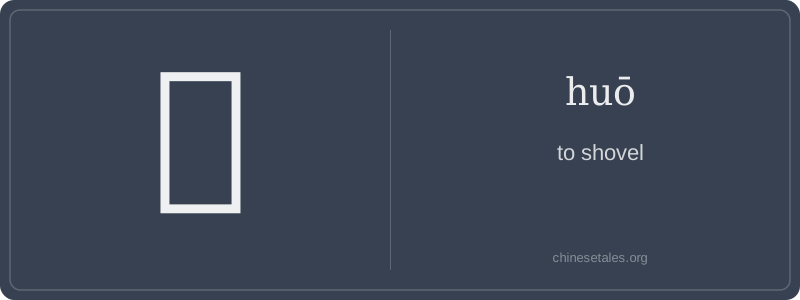
The earliest form of 攉 appears in late Warring States bamboo texts as a compound ideograph: left side 扌 (hand radical), right side 惑 — but not the modern 惑! Ancient inscriptions show the right component as a stylized depiction of a curved shovel blade with a pile of earth beside it, later misinterpreted and standardized into the phonetic component 惑 (huò) during Han dynasty clerical script reform. Over centuries, the 'earth pile' morphed into the 'or' (或) top of 惑, while the shovel’s arc hardened into the 'heart' (忄) base — a visual fossil of tool + action.
This evolution wasn’t arbitrary: classical texts like the Qimin Yaoshu (6th c. CE agricultural manual) use 攉 to describe moving compost and leveling rice paddies — always emphasizing *upward lift and forward toss*. By Ming-Qing vernacular fiction, it gained colloquial vigor: in Water Margin, outlaws ‘shovel’ (攉) earth to bury stolen goods, linking the character to covert, muscular labor. Its shape — 19 strokes, dense and downward-leaning — mirrors the physical strain of lifting heavy loads: the hand radical reaches, the right side weighs down, and the whole character seems to pivot on its lower left stroke like a shovel biting soil.
At its core, 攉 (huō) is a vivid, kinetic verb meaning 'to shovel' — but not just any shovel. It evokes forceful, sweeping motion: think heaving wet sand, scooping gravel, or clearing snow with a heavy metal shovel. The character pulses with physicality — it’s rarely used for delicate actions (that’s 勺 or 撮), and never abstractly like 'shovel data' (English metaphor). Native speakers instinctively pair it with heavy, granular, or resistant materials: dirt, coal, manure, ash.
Grammatically, it’s a transitive verb requiring a direct object and often appears in dynamic contexts: serial verb constructions (e.g., 攉起 → 'shovel up'), resultative complements (e.g., 攉平 → 'shovel flat'), or with aspect particles (了, 过). Learners often misplace it as an intransitive verb ('He shovels') without specifying *what* — but Chinese demands the object: you don’t just 攉; you 攉煤, 攉土, or 攉雪. Omitting it sounds incomplete, like saying 'He verbs.'
Culturally, 攉 carries rustic, labor-intensive connotations — it appears in rural memoirs, factory reports, and construction manuals, but almost never in polite conversation or formal writing. Its absence from HSK reflects its specialized, non-urban register. A common error? Confusing it with 推 (push) or 铲 (scrape/scoop with a flat blade) — but 攉 implies *lifting-and-moving-in-arc*, not sliding or pressing. Also, watch the tone: huō (first tone), not huò or huǒ — mispronouncing it risks sounding like 'sudden enlightenment' (豁) or 'fire' (火).