撵
Character Story & Explanation
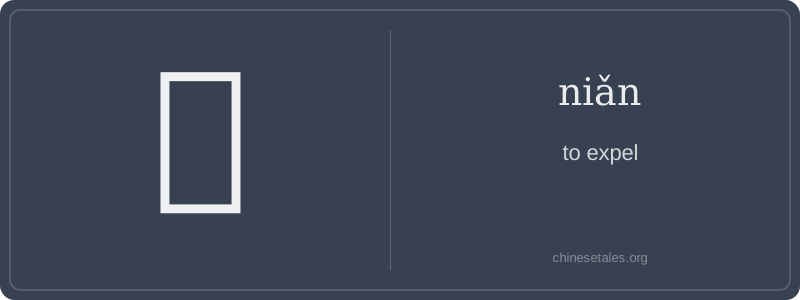
The earliest form of 撵 isn’t found in oracle bones (it’s too late for that), but its structure reveals ancient logic: left side 扌 (hand radical) + right side 尼 (ní), originally a phonetic component borrowed from 尼 (a variant of 泥, 'mud', but here purely sound-based). The character first appeared in Song dynasty texts as a colloquial variant of 趁 (chèn, 'to take advantage of'), then rapidly specialized to mean 'to drive out by hand'. Visually, the 15 strokes build tension — the three dots on top (⺀) suggest urgency or repeated motion; the hand radical anchors the action; and the lower part 尼, though silent in modern Mandarin, once echoed the nasal 'n' sound of niǎn, mimicking the grunting effort of shoving.
By the Ming and Qing dynasties, 撵 had cemented itself in vernacular fiction as the go-to verb for expulsion with moral weight — in *The Scholars*, characters are 撵出宗族 for misconduct; in folk operas, villains 撵寡妇出门 ('shove widows out the door'). Its visual composition — hand + a component suggesting obstruction (尼, historically linked to 'stopping' or 'hindrance') — mirrors its semantic core: using your hands to remove an obstacle-person. Even today, the stroke order forces a downward, outward gesture: the final捺 (nà, 'sweeping stroke') literally pushes rightward — like a palm thrusting someone across a threshold.
At its core, 撵 (niǎn) carries the visceral, physical sense of 'shoving out' — not just politely asking someone to leave, but actively driving them away with hands-on force. Think of a shopkeeper sweeping a stray dog from the doorway with a broom, or a landlord gesturing emphatically toward the street. It’s more urgent and bodily than 推 (tuī, 'to push') or 赶 (gǎn, 'to drive/chase'), and it almost always implies an imbalance of power: the expeller has authority (or at least claims it), and the expelled is resisting or unwelcome.
Grammatically, 撵 is almost always transitive and takes a direct object (e.g., 撵他走, niǎn tā zǒu — 'expel him'). It rarely appears alone; you’ll nearly always see it in compound verbs like 撵走 (niǎn zǒu, 'drive away') or 撵出去 (niǎn chū qù, 'shove out'). Learners often mistakenly use it like the neutral verb ‘remove’ — but 撵 has attitude: it’s blunt, informal, and slightly rough-edged. You wouldn’t say 撵客人离开 in a luxury hotel brochure — that’s too harsh. Instead, it thrives in spoken Mandarin, rural dialogues, and literary depictions of conflict or social exclusion.
Culturally, 撵 echoes historical realities of land tenure and community boundaries — think of villagers 'shoving out' outsiders during famine, or elders 'expelling' a disgraced family member. A common learner trap? Confusing it with 赶 (gǎn), which can mean 'to rush' or 'to drive animals', but lacks 撵’s manual, almost aggressive physicality. Also, note: 撵 is never used for abstract removal (like 'eliminate a problem') — that’s 删 (shān) or 消除 (xiāo chú). Its hands-on radical 扌 is your clue: this action happens with palms, wrists, and weight.