攂
Character Story & Explanation
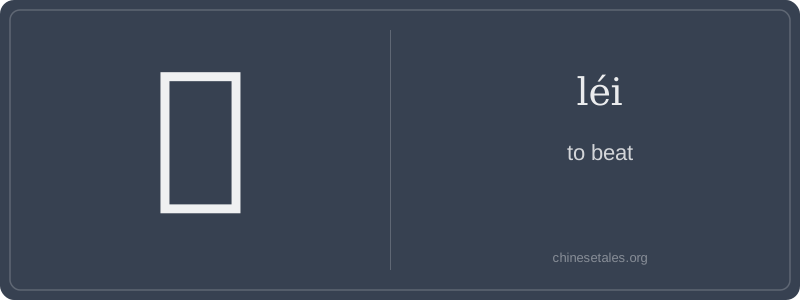
The earliest form of 攂 appears not in oracle bones but in late bronze inscriptions and early seal script, where it was written as ⿰扌畾 — a hand radical (扌) gripping what looks like stacked earth (畾, an ancient variant of 雷 meaning 'thunder', but here functioning phonetically *and* pictorially as 'heavy layered mass'). Over centuries, the right side simplified from 畾 to 雷 (keeping the thunder-like resonance of impact), while the left solidified as 扌. Visually, it’s a hand slamming down on something massive and resonant — like a mallet on stone — capturing both motion and reverberation.
This visual logic shaped its semantic path: in classical texts like the *Shuōwén Jiězì*, 攂 is glossed as 'to strike heavily, to thrash', emphasizing downward force and repeated impact. It appears in phrases like 攂棍 (léi gùn, 'to beat with a club') in Song dynasty legal records, always implying severity and bodily consequence. Unlike 打, which is neutral and ubiquitous, 攂 carried judicial or punitive overtones — the kind of beating that leaves marks, invokes witnesses, or precedes a trial. Its sound léi echoes thunder — not just noise, but the shockwave of sudden, overwhelming force.
Let’s be honest: 攂 (léi) is a linguistic ghost — it’s real, it’s in dictionaries, and it *means* 'to beat' (as in strike physically), but you’ll almost never encounter it in modern speech or writing. It’s not just rare; it’s functionally extinct outside of historical texts, dialectal relics, or deliberate literary archaism. The character carries the visceral, blunt force of a heavy blow — think clubbing, not slapping — and its meaning is tightly bound to physical violence, not metaphorical 'beating' like in English ('beat the system'). You won’t say 'I 攂 my exam'; that’s impossible. Grammatically, it’s a transitive verb requiring a direct object (e.g., 攂人, 攂棍), and it resists aspect particles like 了 or 过 unless in highly stylized classical imitation.
Learners often stumble by confusing it with common beating verbs like 打 (dǎ) or 殴 (ōu), or worse — misreading it as 雷 (léi, 'thunder') due to identical pronunciation and shared top component. That slip turns 'He beat the thief' into 'He thundered the thief' — hilariously nonsensical. Also, don’t expect to type it on standard keyboards: it’s absent from most IMEs and even many digital fonts, signaling how thoroughly it’s faded from active use.
Culturally, 攂 feels like stepping into a Tang dynasty martial manual or a Ming-era vernacular novel — it evokes raw, unmediated physicality, often with moral weight (e.g., righteous punishment). Its near-total disappearance reflects Mandarin’s evolution toward more abstract, softer, or bureaucratic verbs for conflict. If you see it, you’re reading something deliberately archaic, regional, or poetic — not everyday Chinese.