擿
Character Story & Explanation
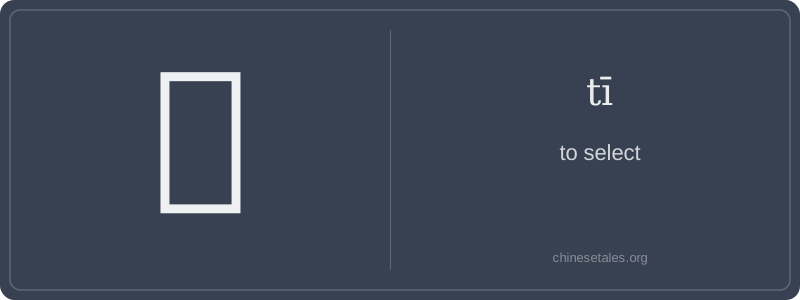
The earliest form of 擿 appears in seal script as a hand (扌) reaching toward a complex element resembling 翟 (zhái), an ancient pictograph of a long-tailed pheasant — prized for its iridescent feathers. In oracle bone inscriptions, the 'pheasant' part symbolized rarity and distinction, while the hand emphasized active choice. Over centuries, the pheasant evolved into the top component 隻 (zhī, originally meaning 'a bird', later 'a unit'), and the hand radical solidified as 扌 — yielding the modern 17-stroke structure: a vigorous hand gesture selecting something uniquely valuable.
This visual logic shaped its meaning: to pick *the best*, not just any. By the Han dynasty, 擿 was used in texts like the Hanshu to describe imperial examination officials 'selecting talent' — always implying rigorous evaluation. Its connection to 隻 (a unit, but also evoking uniqueness) reinforces that 擿 isn’t random picking; it’s identifying *the one* among many. Even today, its shape whispers: 'hand + singular excellence' — a character built on the ancient ideal that true selection honors both the chooser’s wisdom and the chosen one’s merit.'
At its heart, 擿 (tī) is about *deliberate, careful selection* — not just picking something, but plucking it out from a group with precision and intent, like choosing the ripest peach from a basket or singling out a standout student in a crowded class. It carries a quiet authority: the selector knows what matters, and acts accordingly. This isn’t casual ‘choosing’ (选 xuǎn) — it’s curation with purpose, often implying discernment, judgment, or even exclusion.
Grammatically, 擿 is almost always transitive and formal, appearing in written or literary contexts rather than daily speech. You’ll rarely hear it in conversation — instead, you’ll find it in classical allusions, official documents, or refined prose: 擿选 (tī xuǎn) means 'to select after careful scrutiny', and 擿出 (tī chū) means 'to single out' — always with an object and often with a tone of finality. Learners sometimes mistakenly use it where 选 or 挑 (tiāo) would be natural; remember: 擿 feels like a scholar lifting one scroll from a shelf with gloved hands — not a shopper grabbing snacks.
Culturally, 擿 reflects the Confucian value of *discernment as virtue*: good governance, education, and moral cultivation all hinge on the ability to distinguish the worthy from the unworthy. That’s why it appears in phrases like 擿英 (tī yīng, 'selecting the elite') — not flattery, but a solemn responsibility. A common pitfall? Pronouncing it zhì (its rare, archaic reading in compound words like 擿抉), which sounds like 'to dig out' — but for learners, stick firmly to tī and think: 'tickle-select': precise, light, intentional.