擤
Character Story & Explanation
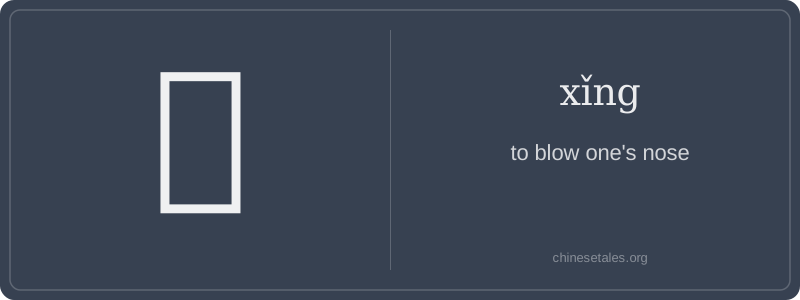
The earliest form of 擤 doesn’t survive in oracle bone script, but its structure reveals its Bronze Age logic: left side 扌 (hand radical), right side 昜 (yáng, an ancient variant of 昜, later simplified to 昜 → then merged with 昜-like forms meaning ‘to rise’ or ‘to lift’ — but crucially, in 擤, the right side is actually a phonetic component derived from 昜 (yáng), which evolved into the modern 省 (xǐng) shape through clerical script simplification. Wait — yes, that’s the twist: the right side looks like 省 (xǐng, ‘to examine’), but it’s purely phonetic here, borrowed for sound, not meaning. Over centuries, the original ‘hand + rising force’ pictorial idea fused into today’s 17-stroke composition: five strokes for 扌, twelve for the complex right-hand component that mimics nasal expulsion through visual density and upward stroke flow.
By the Han dynasty, 擤 appeared in medical manuscripts describing nasal hygiene for treating wind-cold disorders — always paired with verbs like 用 (yòng, ‘to use’) and objects like 手帕 (shǒupà, ‘handkerchief’). Unlike English, where ‘blow one’s nose’ is phrasal, Chinese needed a single, vivid verb — and 擤 delivered: its hand radical grounded it in physical action, while its phonetic anchor (xǐng) subtly echoed 省 (‘to reflect’), perhaps hinting at the self-aware, almost ritualistic pause required before the act — a tiny moment of bodily inspection before expulsion.
At first glance, 擤 (xǐng) feels oddly specific — it doesn’t mean ‘clean’ or ‘wipe’ broadly; it means *only* ‘to blow one’s nose’, and it carries a distinct physicality: the sharp, deliberate, slightly undignified act of expelling mucus through the nostrils. Its core feeling is visceral and bodily — not polite small talk, but raw, unvarnished human function. You won’t find it in formal speeches or poetry; it lives in everyday realism: coughs, colds, winter mornings, and cartoon sneezes.
Grammatically, it’s a transitive verb that almost always takes a direct object — usually 自己的鼻子 (zìjǐ de bízi, ‘one’s own nose’) or just 鼻子 — though colloquially, the object is often dropped when context is clear. It never stands alone like ‘sneeze’ (打喷嚏); instead, it implies *controlled expulsion*, not reflexive action. Learners mistakenly use it where 擦 (cā, ‘to wipe’) or 吸 (xī, ‘to inhale’) would fit — but 擤 is *outward*, *forceful*, and *nasal*. Think: ‘He xǐng-ed his nose loudly’ — not ‘He wiped’ or ‘He sniffed’.
Culturally, 擤 sits on the edge of propriety: it’s functional but rarely elegant. In classical texts, it’s nearly absent — no Confucian gentleman would dwell on such a detail. Today, it appears mostly in descriptive prose, medical contexts, or humorous writing. A common mistake is misreading its radical 扌 (hand) as implying ‘wiping’ — but the hand here isn’t cleaning; it’s *pressing*, *pinching*, and *propelling* — an action requiring precise finger placement against the nostril. That’s why it’s never used for blowing into a tissue *without* hand contact — the gesture is inseparable from the word.