擣
Character Story & Explanation
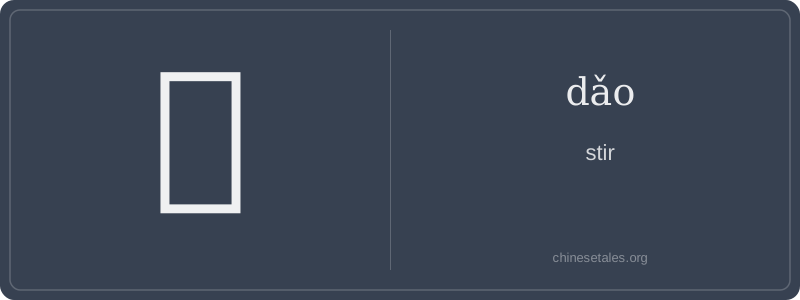
The earliest form of 擣 appears on Warring States bamboo slips — not as a pictograph per se, but as a phono-semantic compound taking shape. Its left side 扌 (hand radical) was already standard for manual actions. The right side, 臼 (jiù), is the real time capsule: a pictograph of a stone mortar — a hollowed-out basin with clear rim and interior depression, unmistakably carved in oracle bone script as ⏚. Over centuries, 臼 evolved from a rounded, squat basin into today’s stylized square-with-dots. The full character 擣 thus literally means 'hand + mortar': the visual logic is unbreakable — you use your hand *at* or *in* the mortar to pound, crush, or stir with force.
This semantic clarity held steady across dynasties. In the *Shuōwén Jiězì* (121 CE), Xu Shen defined it as 'to crush with a pestle', citing medicinal preparation. By Tang poetry, it had gained expressive elasticity: Li Bai used 擣衣 (dǎo yī, 'pounding clothes') — a ritual where women beat laundry on river stones to clean and soften fabric — transforming domestic labor into melancholy imagery (the rhythmic thud echoing loneliness). Even today, the character’s structure mirrors its function: those three horizontal strokes in 臼? They’re the layers of herb, grain, or cloth being compressed — each stroke a pulse of pressure.
At first glance, 擣 (dǎo) feels like a quiet, almost forgotten character — not flashy like 爱 or urgent like 吃, but deeply tactile and physical. Its core meaning is 'to stir', but not the gentle swirling of tea; think pounding, grinding, or vigorously mixing with force — like mortar-and-pestle work or kneading stiff dough. The character carries weight, rhythm, and intention: it’s about applying repeated, downward pressure to transform substance. You’ll rarely hear it in daily chit-chat (hence its absence from HSK), but it thrives in classical texts, culinary instructions, traditional medicine prep, and poetic metaphors for emotional turbulence.
Grammatically, 擣 functions as a transitive verb, almost always followed by a direct object — 擣药 (dǎo yào, 'pound herbs'), 擣蒜 (dǎo suàn, 'crush garlic'). Unlike modern verbs like 搅 (jiǎo, 'stir' — neutral, light), 擣 implies effort, texture change, and even a slight sense of violence — you don’t 擣 water; you 擣 something solid, resistant, or fibrous. Learners often misapply it as a synonym for 搅拌, but that’s like calling hammering 'tapping'. Also beware tone: dǎo (third tone) is easily confused with dào (fourth tone, 'arrive') or dāo (first tone, 'knife') — context saves you, but pronunciation precision matters.
Culturally, 擣 echoes ancient labor: herbalists pounding roots in bronze mortars during the Han dynasty, soldiers grinding grain before marches, poets using it metaphorically — Du Fu wrote of hearts 擣碎 ('crushed to pieces') to convey unbearable grief. It’s a character that smells of crushed ginger and iron pestles. Modern usage is niche but vivid: chefs in Sichuan kitchens still say 擣辣椒 (dǎo làjiāo) for hand-crushed chilies — not chopped, not minced, but *pounded* into pungent, oily paste. That distinction? That’s 擣.