擢
Character Story & Explanation
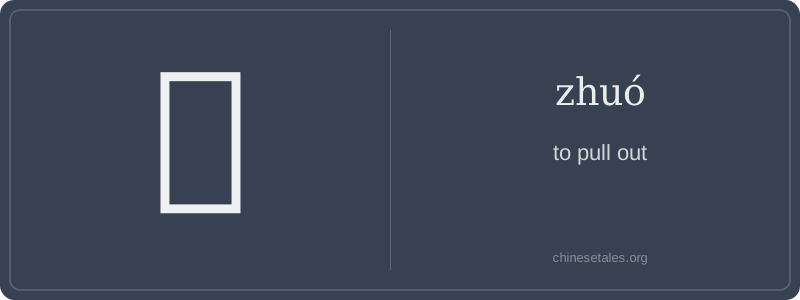
The earliest form of 擢 appears in seal script, where it combines 扌 (hand radical) on the left with 翟 (zhái/zhuó, originally depicting a long-tailed pheasant with elaborate, upward-sweeping feathers) on the right. In bronze inscriptions, 翟 wasn’t just ornamental — its feathery strokes evoked *vertical lift*, like wings rising or plumes unfurling skyward. Over time, the pheasant’s tail morphed into the complex 14-stroke right-hand component we see today, while the left side stabilized as the standard hand radical — transforming the whole character into a visual metaphor: 'a hand lifting something upward, as gracefully and purposefully as a pheasant’s tail rises.'
This imagery anchored its meaning: early uses in the *Zuo Zhuan* and Han dynasty texts describe officials being 擢拔 (zhuó bá, 'pulled up and selected') for virtue — not merely hired, but *elevated from obscurity*. The character’s verticality mirrors classical ideals: talent lies buried like roots, and only discerning hands can draw it upward into light. Even today, 擢 retains this rarefied resonance — it appears in imperial edicts, modern bureaucratic documents, and poetic lines about spiritual awakening, always implying transformation through intentional ascent.
Think of 擢 (zhuó) as the Chinese equivalent of a surgical tweezers — precise, deliberate, and slightly formal. It doesn’t just mean ‘pull out’ in the casual sense of yanking a weed or plucking a hair; it implies *upward extraction with intention*, often from depth or obscurity — like pulling a sapling from soil to transplant it, or elevating a talented official from obscurity to high office. This is no slangy verb: you’ll rarely hear it in daily speech, but it appears with quiet authority in classical texts, political essays, and literary metaphors.
Grammatically, 擢 is almost always transitive and typically paired with abstract or elevated objects: 擢升 (zhuó shēng, 'promote'), 擢用 (zhuó yòng, 'appoint to use'), or even poetic compounds like 擢发难数 (zhuó fà nán shǔ, 'so many crimes they’d fill a forest if each were a pulled hair' — a hyperbolic idiom meaning 'too numerous to count'). Unlike common verbs like 拉 (lā, 'to pull') or 取 (qǔ, 'to take'), 擢 carries no colloquial variants and never stands alone without an object or compound context — saying 'I 擢' would sound as incomplete as saying 'I inaugurate' without specifying what.
Culturally, 擢 embodies Confucian meritocracy: it’s the verb used when talent is *recognized and lifted up* — not self-promoted, but drawn forth by wise authority. Learners often misread its radical (扌) as indicating simple physical action, missing the vertical, aspirational thrust encoded in both form and usage. Also beware: its tone (zhuó, fourth tone) sounds identical to 灼 (zhuó, 'to scorch') — a homophone that shares the same phonetic component (翟), making auditory confusion easy until you see the hand radical.