挢
Character Story & Explanation
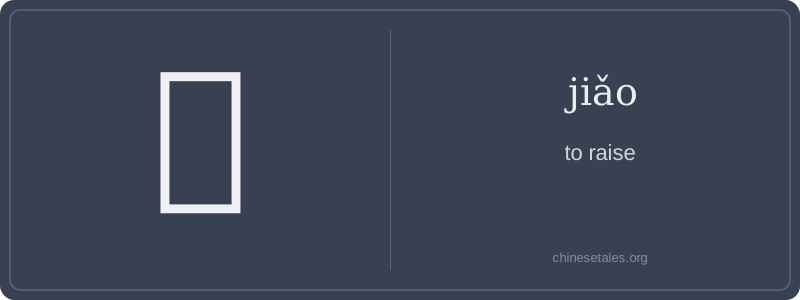
Trace 挢 back to its earliest forms, and you’ll find no oracle bone script — it’s a relatively late arrival, first appearing clearly in Han dynasty clerical script. Visually, it’s a masterclass in functional composition: left side 扌 (hand radical) evolved from the pictograph of a hand reaching out, while the right side 乔 was originally a phono-semantic compound itself — depicting a person standing tall on a platform (the ‘v’-shaped top suggesting uplifted limbs, later stylized into 丿+冂+丨). Over centuries, the hand radical standardized, and 乔 condensed, merging into today’s clean 9-stroke form — every stroke serving purpose, no ornamentation.
Meaning-wise, 挢 didn’t emerge from abstract philosophy but from embodied action: early uses in military texts described soldiers ‘挢旗’ (hoisting banners with a sharp, decisive motion) to signal readiness — the ‘snap’ mattered as much as the height. By the Tang and Song dynasties, poets adopted it for expressive physicality: Du Fu never used it, but later literati did — ‘挢眉’ (arching eyebrows sharply) implied sudden indignation, not calm curiosity. The character’s visual ‘lift’ — both the hand’s reach and 乔’s towering shape — locked in meaning: not just ‘up’, but *up with intention, force, and posture*.
Let’s get tactile with 挢 (jiǎo) — it’s not your everyday ‘raise’! While common verbs like 举 (jǔ) or 抬 (tái) mean ‘to lift’ in neutral, practical contexts (e.g., lifting a box), 挢 carries a subtle but unmistakable nuance of *forceful, upward-directed motion*, often with a slight twist or snap — think of jerking your chin up defiantly, hoisting a heavy pole with a sharp upward thrust, or even the flick of a wrist when raising a banner. Its radical 扌 (hand) tells you right away this is about manual action, and the right side 乔 (qiáo), meaning ‘tall’ or ‘lofty’, acts like a semantic booster: hand + tall = *hand that makes something tall/upright*. This isn’t gentle elevation — it’s intentional, energetic, and sometimes even slightly abrupt.
Grammatically, 挢 is almost always transitive and verb-only — you won’t find it as a noun or adjective. It pairs naturally with body parts (chin, eyebrows, head) or objects requiring physical effort (a pole, banner, or even voice). Learners rarely encounter it in spoken Mandarin (hence its absence from HSK), but it appears with quiet authority in literary descriptions, martial arts manuals, and historical narratives — e.g., ‘他挢起下巴’ (He jutted his chin up) conveys more attitude than ‘他抬起下巴’. A common mistake? Using it where 举 or 抬 would sound more natural — 挢 feels poetic or stylized, never casual.
Culturally, 挢 subtly echoes classical ideals of dignified bearing: in ancient texts, raising one’s head or eyebrows wasn’t just physical — it signaled resolve, pride, or sudden alertness. That’s why you’ll see it in phrases describing heroes ‘挢首而立’ (standing tall, head raised) — not just standing, but *commanding presence*. Modern usage is rare but precise: overuse feels archaic; underuse misses a vivid, kinetic shade of meaning no other character quite captures.