撚
Character Story & Explanation
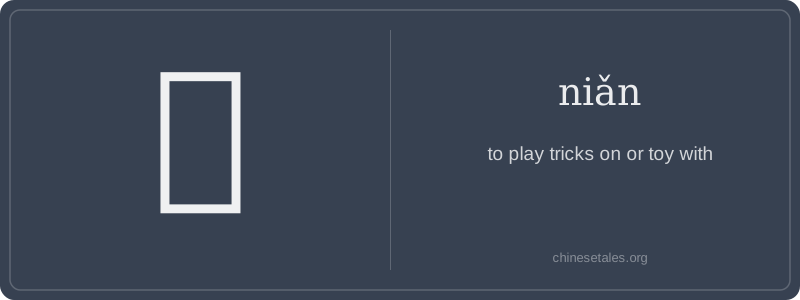
The earliest form of 撚 appears in late Warring States bamboo texts as a compound glyph: the left side was 扌 (hand radical), while the right was a stylized depiction of two fingers pinching and rotating a small round object—originally written as 丿 + 一 + 丿, evoking a bead or pellet turning under fingertip pressure. Over centuries, this right-hand component evolved through clerical script into the modern 丏 (miǎn), a shape that looks like a squinting eye behind a screen—but crucially, it was *never* meant to be read as 丏. Instead, it served purely as a phonetic loan: its pronunciation miǎn sounded close enough to niǎn in Old Chinese dialects to anchor the character’s reading.
This visual origin explains why 撚 feels so tactile and intimate—it’s literally ‘hand + rotational handling’. In the Ming novel Jin Ping Mei, characters ‘niǎn xīn’ (toy with hearts) during flirtations, and in early 20th-century Shanghai satire, journalists ‘niǎn yúlùn’ (manipulate public opinion) with elegant innuendo. The character never meant ‘grind’ or ‘crush’—those are semantic domains of 捻 (niǎn) and 搾 (zhà). Its power has always been psychological: control through lightness, not weight.
Imagine a mischievous child in a Qing dynasty courtyard, gently rolling a jade bead between thumb and forefinger—not to examine it, but to tease the family tutor: flicking it just out of reach, spinning it on the edge of the inkstone, pretending to drop it into the tea cup. That’s 撚 (niǎn): not brute force, not outright deception—but light, deliberate, almost playful manipulation. It carries a tone of condescension or mild mockery: you’re not being harmed, but you *are* being handled—like an object, not a person.
Grammatically, 撚 is almost always transitive and used with an object—often people, reputations, or abstract things like truth or emotions. You don’t ‘niǎn’ alone; you ‘niǎn rén’ (toy with someone), ‘niǎn gōnglǐ’ (play fast and loose with logic), or ‘niǎn yìsī’ (tweak an idea just to see how it bends). It rarely appears in formal writing today, surviving mostly in literary fiction, satirical essays, and regional dialect speech—especially in Wu and Min varieties where its colloquial punch remains sharp.
Watch out: learners often misread it as nián (‘to stick’) due to the ‘hand’ radical and similar sound—but 撚 isn’t adhesive; it’s *agile*. Also, it’s never used for physical crushing or grinding (that’s 捻, with different stroke count and meaning)—a subtle distinction that changes everything. Its charm lies in its precision: it’s the linguistic equivalent of a raised eyebrow, not a slap.