撂
Character Story & Explanation
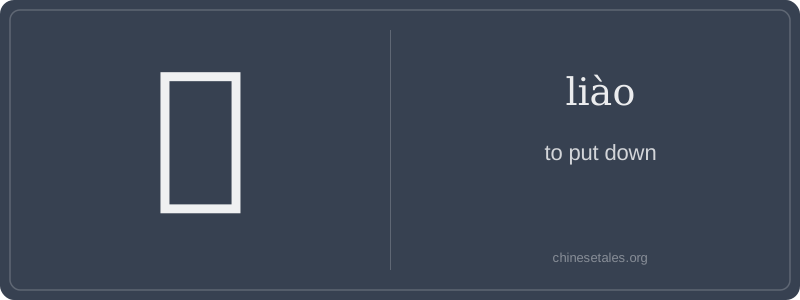
The earliest form of 撂 isn’t in oracle bones, but in late clerical script (Lìshū), where its left side 扌 clearly evolved from 手 (hand), while the right side 高 (gāo, 'tall') was simplified and stylized over centuries. Originally, the right component resembled a person standing atop a platform — suggesting elevation before descent. By Tang dynasty steles, the top stroke of 高 became a horizontal bar, the middle two strokes compressed into a 'mouth-like' shape, and the bottom 'radical' transformed into the modern 口+冋 structure — all while the hand radical remained steadfastly on the left, anchoring the action to the body.
This visual logic — 'hand + high' — captures its semantic core: lowering something from height or status. In classical texts, it appears rarely, but in Ming-Qing vernacular novels like Water Margin, 撂 surfaces in fight scenes: '一枪撂倒' (yī qiāng liào dǎo, 'felled him with one spear thrust') — emphasizing sudden, decisive downward force. The character never meant 'to lift'; its entire history is about gravity, release, and consequence — a perfect fusion of posture and intent.
Imagine you’re in a Beijing teahouse, watching an old master put down his teacup after a long story — not gently, but with a deliberate *thunk*, palm facing down, wrist firm. That’s 撂 (liào): not just 'to put down' like 放 (fàng), but to set something down with finality, weight, or even impatience — a dropped glove, a rejected proposal, a tired sigh made physical. It’s visceral, often colloquial, and carries attitude: this action ends something.
Grammatically, 撂 is almost always transitive and used in spoken Mandarin, especially northern dialects. You’ll hear it in phrases like 撂下 (liào xià) — 'to abandon/leave behind', or 撂挑子 (liào tiāozi) — literally 'drop the carrying pole', meaning 'to quit abruptly'. Unlike 放, which can be neutral or polite, 撂 rarely appears in formal writing or textbooks — it’s the character that shows up when someone’s had enough. Learners mistakenly use it as a direct synonym for 'put', but try saying '我撂书包' instead of '我放书包' — your teacher will raise an eyebrow; you’ve just implied you chucked your backpack across the room in frustration.
Culturally, 撂 thrives in drama, folk speech, and martial arts contexts — think opera performers dramatically 撂袖 (liào xiù, flicking sleeves downward) to signal dismissal. Its roughness makes it a linguistic fingerprint of authenticity: if you hear 撂 in dialogue, you’re hearing real-life rhythm, not textbook Mandarin. Avoid overusing it in formal emails — unless you’re resigning via calligraphy scroll.