摿
Character Story & Explanation
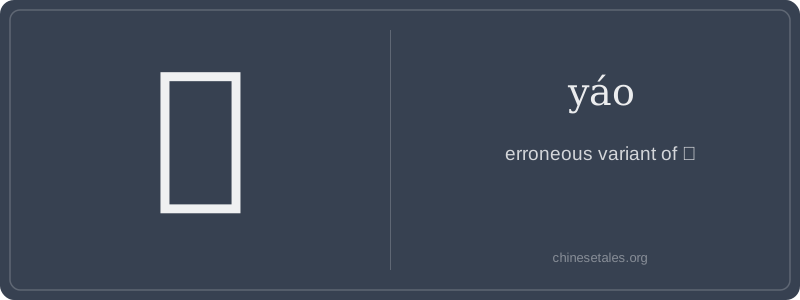
The character 摿 has no genuine ancient origin — it does not appear in oracle bone inscriptions, bronze script, or seal script. It emerged much later, likely during the Ming or Qing dynasties, as a handwritten or woodblock printing variant of 搖. Scribes sometimes miswrote the 右 part (the 'hand' radical 扌 plus the phonetic component 爻) by adding an extra dot stroke or misaligning the two 爻 components — turning the balanced double-x shape into a lopsided, three-dot cluster. Over centuries, this accidental flourish was occasionally reproduced in local editions, especially in medical or Daoist manuscripts where rapid copying invited slips. Visually, 摿 looks like 搖 wearing crooked glasses — same structure, but one eye (dot) popped out of place.
This ‘ghost variant’ never acquired independent meaning or literary presence. Unlike true variant characters (e.g., 裏/裏), 摿 appears zero times in the *Shuōwén Jiězì*, *Kāngxī Zìdiǎn*, or any classical anthology. Its entire history is one of erasure: every major script reform — from Republican standardization to PRC simplification — deliberately excluded it. In fact, the 1955 *First List of Processed Variant Characters* officially abolished it, declaring 摇 (and its traditional form 搖) the sole correct forms. So while 摿 whispers of human fallibility in ink and wood, its legacy is silence — a reminder that language isn’t just what’s written, but what survives editorial rigor.
Here’s the truth no textbook will tell you: 摿 doesn’t really exist — at least, not as a legitimate, independent character in modern standard Chinese. It’s a ghost variant of 搖 (yáo), meaning 'to shake, sway, or wiggle.' Think of it as Chinese orthography’s version of a typo that got fossilized in old print — a scribal slip where the hand slipped and added an extra dot or miswrote the right-hand component. Native speakers don’t use it; dictionaries list it only to warn you away from it. Its 'meaning' isn’t semantic — it’s diagnostic: if you see 摿, you’re almost certainly looking at a pre-1956 typeset error, a regional manuscript quirk, or a font rendering glitch.
Grammatically, since 摿 has no sanctioned usage, it appears *nowhere* in speech, writing, or grammar patterns. You’ll never conjugate it, never use it in a verb-complement construction like 搖晃 (yáo huàng), and never find it in any HSK word list — because it’s not a word. If you type yao in a modern IME, you’ll get 搖 (simplified: 摇), not 摿. Confusing them is like confusing 'definately' with 'definitely' — the former triggers red squiggles everywhere, even if someone once wrote it on a dusty Qing dynasty ledger.
Culturally, 摿 reveals how deeply Chinese values precision, standardization, and historical continuity — yet also tolerates charming imperfection in archives. Scholars treat it like a linguistic fossil: useful for dating texts or spotting forgery, but utterly irrelevant for communication. Learners’ biggest mistake? Wasting mental energy memorizing it. Your time is better spent mastering 摇’s six common compounds — which all mean something real, vivid, and swaying.