摽
Character Story & Explanation
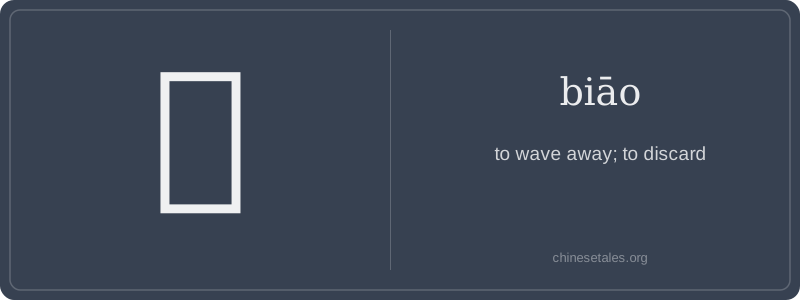
The earliest form of 摽 appears in Warring States bamboo slips as a hand radical (扌) gripping a stylized ‘biāo’ shape—originally depicting a hand holding and sharply flicking a flexible reed or whip. The right side, now written as 票, evolved from a pictograph of a banner fluttering violently in wind (the ‘feather’ component 羽 atop ‘fire’ 灬, suggesting rapid, heated motion). Over time, the banner simplified into 票, while the hand radical solidified as 扌—14 strokes total, each one echoing that swift, decisive gesture.
By the Han dynasty, 摽 shifted from literal ‘flicking a reed’ to metaphorical ‘discarding falsehoods’—a meaning cemented in the Shuōwén Jiězì (c. 100 CE), which defines it as ‘to cast off what is unworthy.’ In Tang poetry, Li He used 摽 in ‘摽尽浮名’ (waving away all hollow fame), linking physical motion to ethical renunciation. Its visual duality—hand + fluttering banner—perfectly captures how Chinese characters encode both action and attitude: not just removal, but *ritualized release*.
Imagine you’re at an old Qing dynasty teahouse, and a scholar suddenly flicks his sleeve—*biāo!*—sending a stray moth fluttering out the window. That sharp, dismissive motion is 摽: not just ‘to discard,’ but to *wave away with deliberate, almost theatrical contempt*. It’s visceral, physical, and slightly archaic—like tossing a bad omen into the wind. You’ll rarely hear it in daily speech, but it lives on in classical idioms and literary descriptions of rejection or expulsion.
Grammatically, 摽 is a transitive verb, always taking a direct object (e.g., 摽出 ‘wave out’, 摽开 ‘flick aside’). It’s often paired with directional complements (出, 开, 去) or used in passive-like constructions like 被...摽出. Learners mistakenly use it like modern 抛 or 扔—but 摽 isn’t about force or carelessness; it’s about *graceful dismissal*, implying agency and intention. You wouldn’t 摽 your trash—you’d 摽 a slanderous rumor from court records.
Culturally, 摽 carries moral weight: in Ming-Qing fiction, officials ‘bīāo’ corrupt petitions to preserve integrity; Daoist texts describe ‘bīāo’ worldly attachments as a spiritual act. A common mistake? Confusing its pronunciation: biāo is standard for ‘discard’; biào appears only in rare dialectal or phonetic loan usages (e.g., certain regional pronunciations of 飙), never in standard literary contexts. So unless you’re reading a 17th-century Fujian opera script, stick with biāo.