摴
Character Story & Explanation
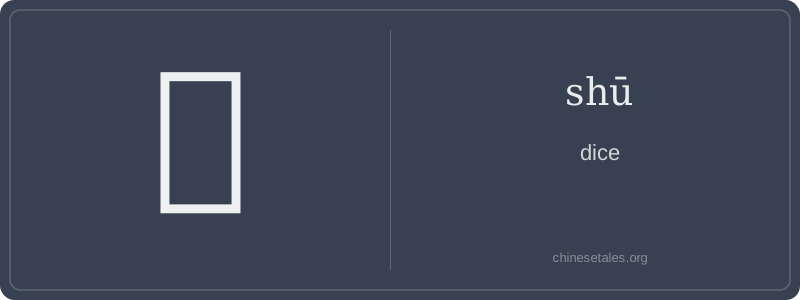
The earliest form of 摴 appears in Han dynasty bamboo slips—not oracle bones—as a compound ideograph: left side 扌 (hand radical), right side 舒 (shū, ‘to spread out, relax’), but with a crucial twist: the top of 舒 was originally written as 余 (yú), a phonetic component hinting at pronunciation, while the bottom was 曰 (yuē, ‘to speak’), later stylized into the modern 舍-like shape. Over centuries, the hand radical remained stable, but the right side condensed, losing its clear phonetic logic and morphing into today’s abstract form—six strokes that subtly echo the six faces of a die.
This character first appeared in the *Shuōwén Jiězì* (121 CE) as ‘a gaming implement used in liubo’, and by the Northern Wei period, it was already paired with 蒱 (pú) in the compound 摴蒱—referring specifically to dice-and-board games involving strategy and luck. In Du Fu’s poetry, 摴 symbolizes fleeting fortune; in the *Book of Rites*, it’s cited as a tool for teaching probability and decorum. Its visual austerity—no dots, no pips—mirrors the Confucian ideal: the *idea* of chance matters more than the object itself.
Imagine a bustling Tang dynasty tavern at night: lanterns flicker, scholars debate poetry, and in the corner, two men lean over a lacquered board, shaking a bamboo cup—*clack-clack-clack*—before slamming it down. Out tumble six ivory cubes, each face carved with red dots: 摴 (shū). This isn’t just ‘dice’ as we know it—it’s *the* classical Chinese gaming die, historically made of bone, ivory, or jade, used in high-stakes games like *liubo* and later *shuibo*. The word carries weight: elegance, chance, and a whiff of scholarly leisure—or reckless gambling.
Grammatically, 摴 is almost always noun-only and highly literary; you’ll never hear it in modern spoken Mandarin. It appears only in fixed compounds (like 摴蒱 or 摴博) or classical allusions—not as a standalone object (*I rolled the dice* → never *我掷了摴*). Learners mistakenly treat it like a generic term for ‘dice’ (which is 骰子 tóuzi in speech), but 摴 is strictly archaic and poetic. Using it in daily conversation sounds like quoting Confucius mid-ordering bubble tea.
Culturally, 摴 evokes the tension between cultivated play and moral peril: Tang poets praised its artistry, while Ming moralists condemned 摴蒱 as ‘the gateway to ruin’. A common error? Confusing it with 易 (yì, ‘change’) or 博 (bó, ‘broad’)—both visually similar but semantically worlds apart. Remember: 摴 belongs in silk scrolls and annotated anthologies, not on your phone’s dice app.