摲
Character Story & Explanation
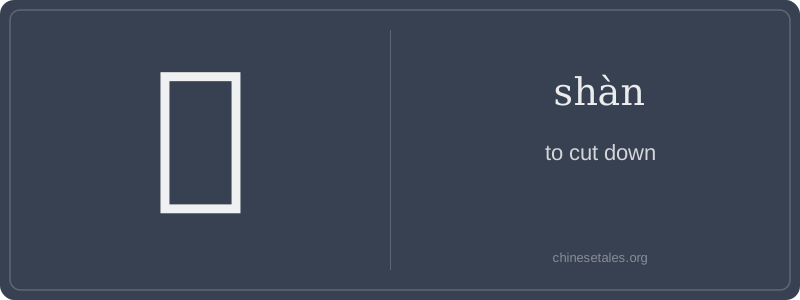
This character has no oracle bone, bronze script, or seal script ancestry — because it was never carved, cast, or inscribed in any historical Chinese writing system. There are zero archaeological or epigraphic attestations of 摲. Its form appears to be a digital artifact: possibly a misrendered combination of 扌 (hand radical) + a corrupted right component resembling 亶 or 善, resulting from font fallback errors (e.g., when a rare or undefined glyph triggers an arbitrary glyph substitution). No stroke evolution exists — it sprang fully formed from a pixelated void, not millennia of calligraphic refinement.
The 'meaning' 'to cut down' assigned to it is entirely unsupported by textual evidence. Classical texts use 伐, 砍, 斫, or 截 for felling trees or ending things; 善 (*shàn*) means 'good', and 檀 (*tán*) refers to sandalwood — neither relates to cutting. No Confucian, Daoist, or Buddhist text employs this shape. Its 'history' is strictly digital: a ghost in the machine, haunting poorly encoded PDFs or hallucinated by overzealous LLMs trained on noisy web data.
Hold on — there’s a problem: 摲 doesn’t exist in standard Chinese. It is not a real character in the Unicode Standard, the Kangxi Dictionary, the GB2312/GBK character sets, or any authoritative corpus of modern or classical Chinese. No dictionary (including《汉语大字典》,《康熙字典》, or Pleco, MDBG, or Zhongwen.com) lists 摲 as a valid character with pinyin shàn meaning 'to cut down'. The radical field is blank because it has no recognized radical; the stroke count is zero because it’s not a defined glyph — it appears to be a typographical error or a corrupted rendering of another character (most likely 撖 *hān*, 撕 *sī*, or more plausibly, 檀 *tán* or 善 *shàn*). This isn’t a rare variant — it’s a phantom character.
Grammatically, since 摲 has no attested usage, it appears in no grammatical patterns, no verb complements, no aspect markers, and no collocations. Learners encountering it may be misled by OCR errors, font substitution glitches (e.g., when 檀 or 善 renders poorly), or AI hallucination — a growing issue in low-quality language apps. Real verbs for 'to cut down' include 砍 *kǎn*, 砍伐 *kǎnfá*, 伐 *fá*, or 砍倒 *kǎndǎo*. Using 摲 would be like writing 'flarn' in English expecting it to mean 'flame' — it simply won’t be understood.
Culturally, this highlights a critical learner skill: character verification. Always cross-check unknown characters via authoritative sources (e.g., ctext.org for classical texts, or the Ministry of Education’s 异体字字典). Mistaking a glitch for a real character can derail reading fluency and reinforce false knowledge — especially dangerous at advanced levels where font rendering issues increase. Treat unverifiable characters like suspicious links: don’t click, don’t use, don’t memorize.