摰
Character Story & Explanation
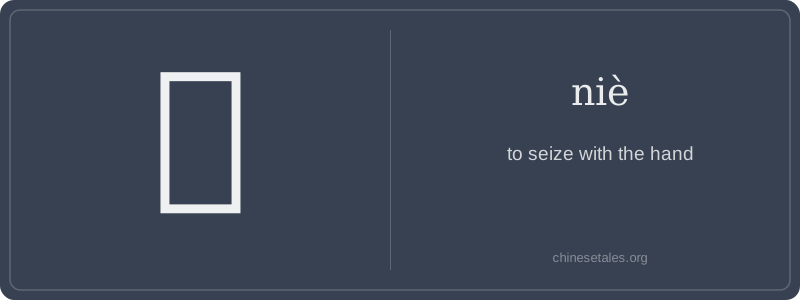
The earliest form of 摰 appears in bronze inscriptions of the late Zhou dynasty — not as a standalone character, but embedded in compound glyphs depicting 'hand grasping a bound person’s neck or garment'. The left side was 扌 (hand radical), while the right side evolved from a pictograph resembling a twisted rope or coiled arm (the now-archaic component 聶, which itself meant 'to whisper closely', later repurposed for sound). Over centuries, the rope-like strokes simplified into three stacked '耳' (ear) shapes — a phonetic loan that had nothing to do with hearing but perfectly captured the sharp, repeated motion of gripping and twisting.
By the Han dynasty, 摰 entered texts like the *Shuōwén Jiězì* as a 'forceful hand action', used in legal and military contexts — 'to seize by the collar', 'to wrest away authority'. In the Tang-era *Yùtái Xīn Yǒng* (New Songs from the Jade Terrace), it described a heroine snatching her own hairpin to wound a captor — a gesture of defiant agency. Its visual structure still echoes that ancient image: three 'ears' stacked like knuckles tightening, while the hand radical anchors the action in physical will. Even today, seeing those triple 'ear' strokes makes native readers subconsciously feel the pressure — not of sound, but of *squeeze*.
At first glance, 摰 (niè) feels like a linguistic fossil — it’s not in the HSK, rarely appears in modern textbooks, and even many native speakers hesitate before using it. Yet its core meaning — 'to seize with the hand' — is visceral and precise: not just 'grab', but *a sudden, forceful, often deliberate hand-action*, implying control, urgency, or even aggression. Think less 'pick up your keys' and more 'snatch the evidence before it’s seen'. It carries weight — like the grip of a magistrate seizing a confession or a warrior wrenching a weapon from an enemy’s grasp.
Grammatically, 摰 functions almost exclusively as a literary verb, usually in classical or semi-classical constructions. It rarely stands alone; instead, you’ll find it in tightly packed four-character idioms (chéngyǔ) or historical narratives. You won’t say 'I 摰 the door handle'; you *might* read '他一手摰住叛臣衣领' ('He seized the traitor’s collar with one hand') in a Ming-dynasty novel. Learners mistakenly treat it like common verbs such as 抓 (zhuā) or 拿 (ná), but 摰 resists colloquial use — it’s reserved for moments of high dramatic tension or moral gravity.
Culturally, 摰 reflects how Chinese writing preserves semantic precision across millennia: when a single character can convey 'hand + violent seizure + intent', it signals that ancient scribes valued economy *and* intensity. A common mistake? Assuming it’s interchangeable with 握 (wò, 'to hold') — but 握 implies calm control; 摰 implies rupture. Also, beware tone: niè (4th tone) is easily mispronounced as niē (1st tone, 'to pinch'), which changes everything. This isn’t a word you ‘learn’ — it’s one you *encounter*, like an artifact in a museum.