摮
Character Story & Explanation
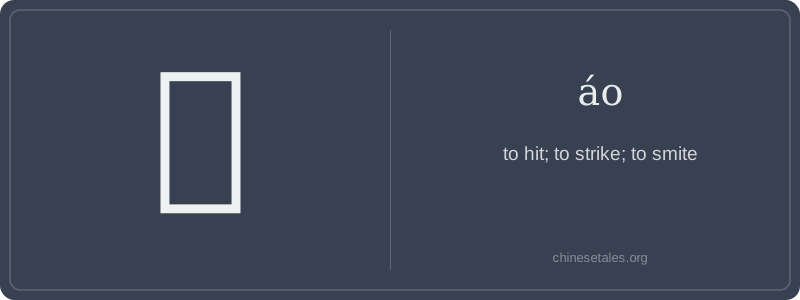
The earliest form of 摮 appears in late Warring States bamboo slips and Han dynasty seals, not oracle bones — and it’s a masterclass in semantic fusion. Its left side, 扌 (hand radical), is clear, but the right side, 敖, is the real star: originally a pictograph of a person standing tall on a mound (meaning ‘to wander freely’ or ‘to be arrogant’), later stylized into 敖. When combined, 扌 + 敖 visually suggests ‘a hand acting with proud authority’ — not random violence, but a commanding, elevated strike. Over centuries, the top stroke of 敖 softened, the horizontal strokes condensed, and the final dot stabilized, yielding today’s elegant yet forceful shape.
This visual logic mirrors its semantic evolution: from early texts like the Zuo Zhuan, where 摮 described ritual punishments meted out by sovereigns, to Tang poetry, where poets used it metaphorically — e.g., ‘wind 摮ing the clouds apart’ — implying an unstoppable, majestic force. Unlike generic verbs of impact, 摮 always implies agency, intention, and scale. Even in modern usage, it’s reserved for moments that feel mythic: a typhoon 摮 across the coast, or reformers 摮ing open old systems.
Let’s cut through the noise: 摮 (áo) isn’t just ‘to hit’ — it’s a *deliberate, forceful, often righteous strike*, like a judge slamming a gavel or a general striking down rebellion. It carries moral weight and dramatic intensity, rarely used for casual taps or light knocks (those are 打 dǎ or 敲 qiāo). Think of it as the verbal equivalent of a thunderclap: sudden, authoritative, and consequential.
Grammatically, 摮 is almost always transitive and appears in literary, historical, or rhetorical contexts — not daily chit-chat. You’ll find it in classical idioms (e.g., 摮天盖地), formal speeches, or poetic descriptions of cosmic or political upheaval. It doesn’t take aspect particles like 了 or 过 easily; instead, it prefers classical verb complements (e.g., 摮倒 áo dǎo — ‘to strike down’) or reduplicated forms (e.g., 摮摮 áo áo) for emphatic repetition. Learners mistakenly plug it into modern conversational sentences like ‘I hit the table’ — but native speakers would say 我拍了桌子, never 我摮了桌子.
Culturally, 摮 evokes ancient justice and celestial power — it’s the verb used when Heaven ‘strikes down’ the unworthy (天摮 èr rén), or when a hero ‘smites’ tyranny. Misusing it sounds archaic or comically overblown — like shouting ‘I shall smite this sandwich!’ before lunch. Also, note its tone: áo is second tone, rising — imagine your voice lifting with the arc of a sweeping blow.