摭
Character Story & Explanation
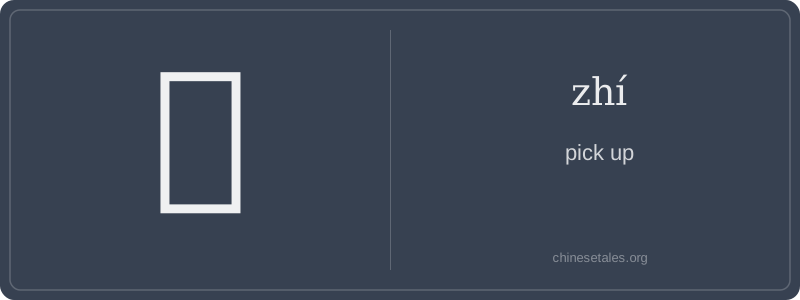
The earliest form of 摭 appears in bronze inscriptions as a hand (扌) reaching toward a cluster of grain stalks or scattered dots — symbolizing selective gathering from a larger field. Over time, the right side evolved from a pictograph of ‘scattered grains’ (possibly related to 執, meaning ‘to hold firmly’) into today’s 翟 (zhí), which originally depicted a long-tailed pheasant — its ornate, feathery tail visually echoing the idea of ‘many pieces gathered together’. The left-hand radical 扌 (hand) remained constant, anchoring the action.
By the Han dynasty, 摭 had crystallized its literary meaning: not just physical collection, but the scholar’s act of extracting authoritative phrases from classics. The Shuōwén Jiězì (121 CE) defines it as ‘to pick out and take — especially rare or essential words’. In Tang poetry and Song essay collections, 摭 appears in phrases like ‘摭前言以立论’ (‘select past sayings to build one’s argument’), cementing its role as the verb of intellectual curation — where every picked fragment must carry semantic weight.
Think of 摭 (zhí) as the Chinese equivalent of 'curating' — not in the Instagram sense, but like a meticulous archivist sifting through dusty scrolls to pluck out only the most telling fragments. It’s not casual picking up (that’s 拿 or 捡); it’s selective, deliberate, often intellectual gathering — of words, evidence, or ideas. You wouldn’t 摭 an apple from a tree; you’d 摭 quotations from ancient texts.
Grammatically, 摭 is almost always transitive and formal — it appears in written language, academic discourse, and classical-style prose. It pairs naturally with abstract objects: 摭取 (zhíqǔ) ‘to excerpt’, 摭拾 (zhíshí) ‘to collect piecemeal’. Note: it never stands alone as a verb in speech — you’ll rarely hear ‘I 摭 this quote’; instead, it’s embedded in compounds like 摭录 (zhílù, ‘to excerpt and record’) or used in passive-voice constructions like ‘被广泛摭引’ (‘widely cited’).
Culturally, 摭 carries scholarly weight — it evokes Confucian literati poring over classics, selecting passages to support moral arguments. Learners often misread it as a variant of 拾 (shí, ‘to pick up’), but that’s a serious faux pas: 拾 is neutral and physical; 摭 is intentional and intellectual. Also, watch the tone: zhí (2nd tone), not zhǐ or zhī — mispronouncing it risks sounding like ‘value’ (值) or ‘only’ (只).