摦
Character Story & Explanation
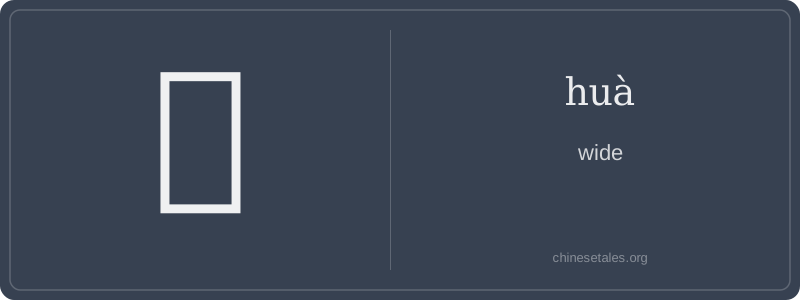
The earliest form of 摦 appears in bronze inscriptions as a striking pictograph: two parallel horizontal lines (representing earth or ground) with a large, open, angular shape above — possibly stylized arms stretched wide, or a broad expanse of sky over land. Over centuries, the upper element simplified into the 'huò' component (the 'wide' semantic core), while the left-hand radical evolved from 手 (hand) to 扌 (hand radical), reflecting its original association with *spreading* or *extending* — a gesture of opening space. By the Han dynasty, the character had stabilized into its current structure: 扌 + 摦.
This visual logic shaped its meaning journey. In the Shuōwén Jiězì (121 CE), it’s defined as 'to extend broadly' — emphasizing active expansion, not static width. Classical poets like Du Fu used 摦 in phrases like 摦然 (huò rán) — 'suddenly vast', describing epiphanic clarity. Notice how the hand radical anchors it in human action: width isn’t passive — it’s something we *make*, *enact*, *embody*. That’s why it thrives in compounds about vision (豁达), spirit (豁朗), and insight (豁然开朗) — all implying a conscious, generous opening of perception.
Let’s be honest: 摦 (huà) is a quiet rebel — it means 'wide', but it almost never stands alone in modern Mandarin. You won’t hear someone say 'This road is 摦' — instead, it lives deep inside compound words and classical phrasing, lending a poetic, almost architectural sense of expansiveness. Think less 'broad shoulders' and more 'vast, unbroken horizon'. Its core feeling is spatial generosity — not just physical width, but openness, scope, and even moral breadth (as in classical texts describing 'wide-mindedness').
Grammatically, 摦 functions almost exclusively as a morpheme within disyllabic words — never as a standalone adjective like 宽 (kuān). You’ll see it in formal or literary contexts: 摦阔 (huò kuò) meaning 'vast and boundless', or 摦大 (huò dà) for 'grand in scale'. Crucially, it never takes degree adverbs ('very', 'too') or comparative forms — that’s a red flag for learners! Using it like an English adjective (e.g., *这个房间很摦) is a classic fossilized error.
Culturally, 摦 carries the weight of classical Chinese aesthetics — it evokes the Daoist ideal of spaciousness and the Confucian virtue of magnanimity. Learners often misread it as 宽 because they sound similar and share the 'wide' meaning, but that’s like confusing 'serene' with 'calm' — same neighborhood, different grammar, different soul. And yes — you’ll rarely encounter it outside advanced reading or poetry. It’s not hiding; it’s waiting respectfully in the wings.