摙
Character Story & Explanation
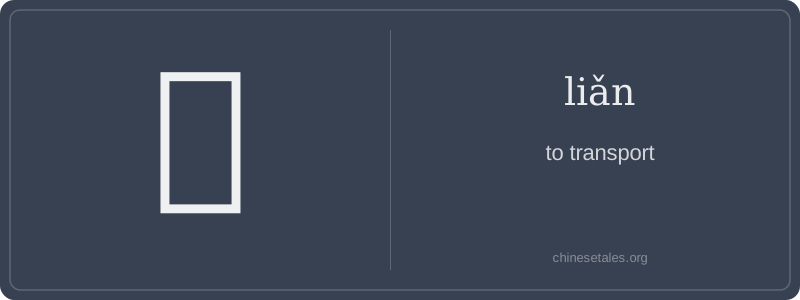
The earliest form of 摙 appears in Han-dynasty clerical script, not oracle bones — because it’s a relatively late semantic compound. Its left radical 扌 (hand) is clear, but the right side is the key: it’s a stylized 尚 (shàng), meaning 'above' or 'still', but here acting phonetically while also hinting at elevation — think of lifting something *up* onto the shoulder. Over centuries, the top strokes simplified, the middle horizontal lines thickened, and the bottom ‘small’ component (小) evolved into the current 口-like shape — not a mouth, but a visual echo of a balanced load resting atop the body.
This character emerged during the Han–Tang transition, precisely when canal transport boomed and human porterage became systematized. Classical references are sparse — it’s absent from the Analects or Dao De Jing — but shows up in Tang-era tax records describing grain consignments: '每夫摙米三石' ('Each porter carried three shi of rice'). The hand + 'upward' structure isn’t metaphorical — it’s anatomical: the act of placing a pole across the trapezius muscle, then hoisting weight *up* into balance. Even today, dialect speakers gesture by tapping their shoulder when saying 摙 — a living fossil of its origin.
Imagine a bustling late-Imperial Chinese dockside: bamboo poles slung across shoulders, heavy wicker baskets of rice swaying with each step, sweat dripping onto packed earth — and the rhythmic chant of laborers shouting 'liǎn! liǎn!' as they heave crates onto river junks. That’s 摙 in action: not just generic 'transport', but *manual, shoulder-borne conveyance* — the kind that strains your back and builds calluses. It’s visceral, physical, and deeply rooted in pre-industrial logistics.
Grammatically, 摙 is almost always a verb, typically transitive and often paired with concrete objects (grain, timber, bricks) and directional complements like 上 (shàng) or 下 (xià). You’ll rarely see it in isolation — it thrives in compound verbs like 摙上 (liǎn shàng, 'to hoist up') or 摙下 (liǎn xià, 'to lower'). Crucially, it’s *not* used for vehicles ('I drove the truck' ≠ 我摙了卡车); that’s 运 (yùn) or 载 (zài). Learners mistakenly use 摙 for modern transport — a red flag that instantly dates your Mandarin to the Qing dynasty!
Culturally, 摙 carries the quiet dignity of manual labor — it appears in regional operas, folk songs from Sichuan and Shaanxi, and oral histories of porters on the Yangtze gorges. Its near-absence from HSK reflects how standardized Mandarin sidelined regional, embodied vocabulary — yet it survives vividly in dialects, historical novels, and heritage reenactments. Don’t force it into daily chat; deploy it when evoking grit, tradition, or tangible weight — and you’ll sound authentically grounded.