摓
Character Story & Explanation
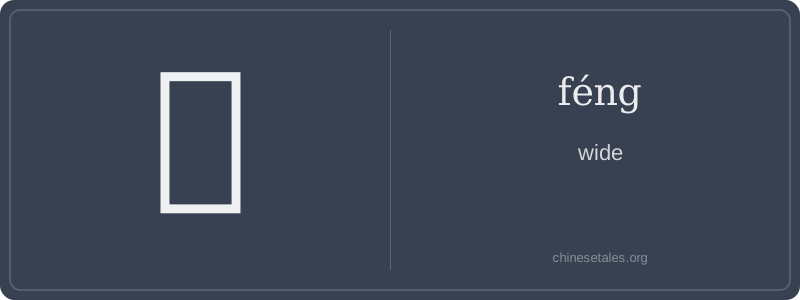
The earliest form of 摓 appears in bronze inscriptions as a compound pictograph: the left side was 扌 (hand radical), and the right side resembled 丰 (fēng), which originally depicted abundant grain stalks standing tall and evenly spaced—symbolizing fullness, height, and orderly expansion. Over centuries, the hand radical evolved into its modern form, while the 丰 component simplified and rotated slightly, preserving its core idea of upright, generous spacing. By the Han dynasty, the character stabilized into today’s shape: a hand action suggesting deliberate opening, paired with the visual rhythm of 丰’s three horizontal strokes—like three parallel horizons stretching out.
This visual logic directly shaped its meaning: 摓 didn’t just mean ‘wide’—it meant ‘widened intentionally,’ ‘opened with composure.’ In the Zuo Zhuan, it appears in descriptions of ritual spaces prepared for ceremonies—where width wasn’t mere measurement, but moral readiness. Later, in Tang poetry, poets used 摓 to describe minds ‘opening widely’ after enlightenment. Its enduring resonance isn’t spatial, but psychological: the calm, uncluttered expanse of a settled heart.
Think of 摓 (féng) as the Chinese equivalent of the word 'spacious'—but with the quiet, almost architectural gravitas of a Japanese Zen garden: not just 'wide,' but wide in a way that implies measured openness, calm expanse, and dignified emptiness. It’s not the boisterous width of a football field, but the serene breadth of a mist-covered mountain valley—poetic, classical, and deeply visual.
Grammatically, 摓 is almost exclusively an adjective used in literary or poetic contexts—not daily speech—and it almost never stands alone. You’ll find it in fixed four-character phrases (e.g., 摓然开朗), or modifying nouns with classical modifiers like ‘而’ or ‘以’. You won’t say *‘这个房间很摓’*—that sounds jarringly archaic, like saying ‘This room is capacious’ at a coffee shop. Instead, it appears in elegant compounds or classical-style descriptions: ‘天地摓阔’ (the heavens and earth are vast and open).
Learners often misread it as a variant of 逢 (féng, 'to meet') or 冯 (féng, surname) due to identical pronunciation and rare usage—but 摓 carries zero relational or personal connotations. Its danger lies in overuse: inserting it where 宽 (kuān) or 广 (guǎng) would sound natural makes your Mandarin instantly sound like a Tang dynasty scroll read aloud at a tea ceremony. It’s not wrong—it’s *too right* for modern ears.